About Ratufa indica (Erxleben, 1777)
Taxonomy and Common Name
The Indian giant squirrel, with the scientific name Ratufa indica (Erxleben, 1777), is one of the largest squirrel species.
Body and Tail Length
Its head-and-body length ranges from 25 to 50 cm (10 inches to 1 foot 8 inches), and its tail is around the same length or slightly longer.
Weight Range
Adults typically weigh 1.5 to 2 kg (3.3 to 4.4 lb), though rare individuals can reach up to 3 kg (6.6 lb).
Average Morphometrics
The average head-and-body length for both sexes is about 36 cm (1 foot 2 inches), average tail length is 45 cm (1 foot 6 inches), and average weight falls between 1.7 and 1.8 kg (3.7 to 4.0 lb).
Color Pattern Type
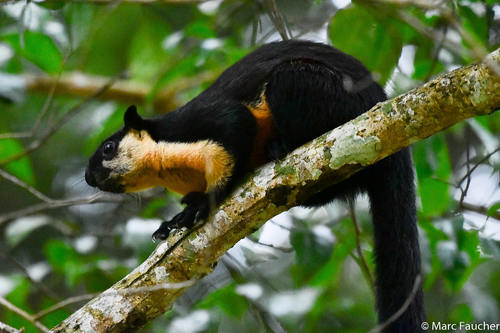
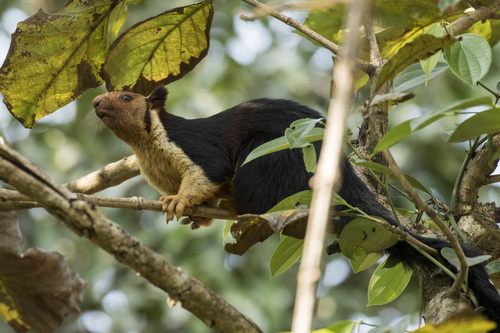
This squirrel has a noticeable one-, two-, or three-toned color pattern.
Possible Fur Colors
Possible coloration includes whitish, creamy-beige, buff, tan, rust, reddish-maroon, brown, dark seal brown, or black.
Body Part Coloration
Its underparts and front legs are usually cream colored, its head may be brown or beige, and it has a distinct white spot between the ears.
Subspecies Color Variation
Exact coloration varies by subspecies.
Geographic Range
This species is endemic to India, and its range covers parts of the Western Ghats, Eastern Ghats, and Satpura Range, extending as far north as Madhya Pradesh, at approximately 22° N.
Altitude and Habitat
It occurs at altitudes between 180 and 2,300 m (590 to 7,550 ft), living in tropical deciduous, semi-deciduous, and moist evergreen forests and woodlands; in semi-deciduous habitats it often uses denser riparian growth.
Distribution Fragmentation
Its overall distribution is fragmented, as it cannot tolerate habitat degradation.
Nesting Behavior
To avoid predators, the Indian giant squirrel typically builds its nests in taller trees, with a mean nest tree height of 11 m (36 ft) (±3 m / 10 ft standard deviation).
Congener Breeding Period
Information about captive breeding of the closely related Malayan giant squirrel notes that births occur in March, April, September, and December.
Newborn Congener Measurements
Newborn Malayan giant squirrel young weigh 74.5 g at birth and measure 27.3 cm in length.