About Symphodus caeruleus (Azevedo, 1999)
Taxonomic Distinctiveness
Symphodus caeruleus is a species of wrasse that grows larger than any of its sympatric close relatives found in the Azores, and it has distinct meristic counts.
Fin Meristics
This species has 17 to 18 spines and 8 to 9 rays in its dorsal fin, and 5 to 6 spines and 7 to 9 rays in its anal fin.
Scale Count
It has 33 to 34 scales along its lateral line.
Female Coloration
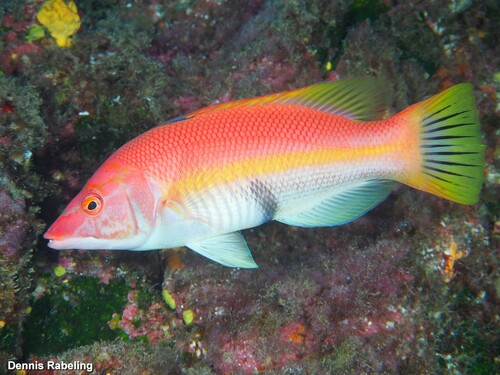
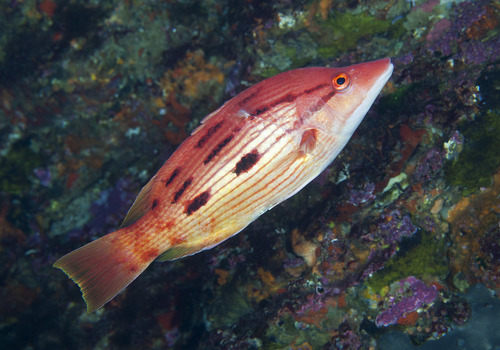
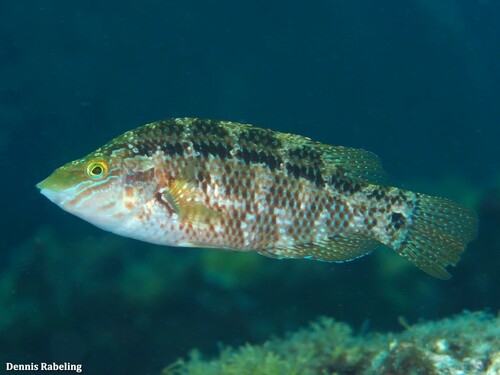
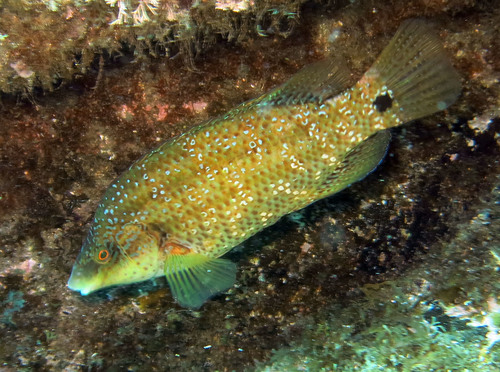
Females are overall brownish in colour, fading to a lighter shade towards the ventral side of the body, and have a chequered pattern of dark brown spotting across their body.
Body Spot Pattern
There are four elongated spots on the body, plus a fifth spot on the caudal peduncle that extends onto the proximal portion of the caudal fin.
Fin Spot Pattern
This spot pattern is also mirrored in the dorsal and anal fins.
Terminal Male Coloration
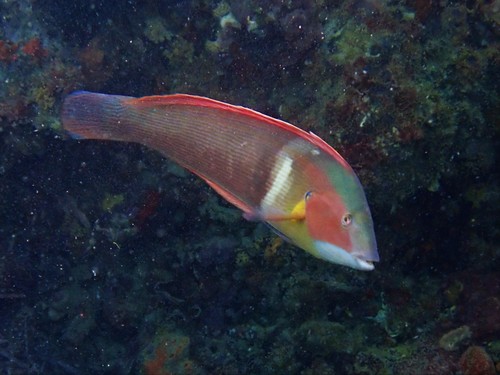
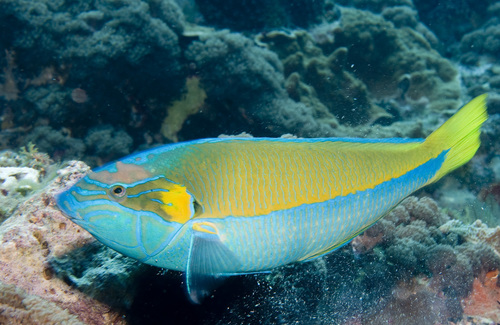
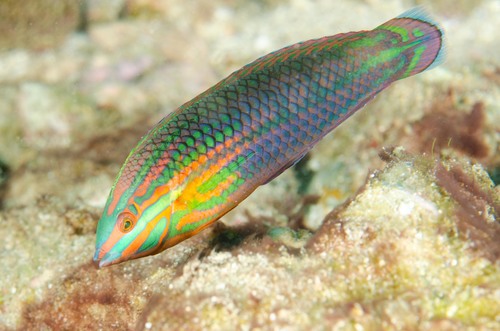
Terminal phase males are dark greenish-blue, becoming even bluer during the breeding season.
They have paler fins and a pattern of darker spots similar to the pattern seen in females.
Size
Males can reach a standard length of 21.5 centimetres (8.5 in), while females grow to a maximum standard length of 17.5 centimetres (6.9 in).
Distribution
Symphodus caeruleus is endemic to the Azores, where it occurs in the eastern Atlantic Ocean.
Habitat
This species inhabits shallow, inshore rocky reefs that have a good covering of algae; the fish uses this algae for cover, feeding, and nesting.
Reproductive Biology
Like many other wrasse species, Symphodus caeruleus is a protogynous hermaphrodite.
Sexual Maturity Size
Males reach sexual maturity at a total length of 12 centimetres (4.7 in), while females reach sexual maturity at a total length of 14 centimetres (5.5 in).
Sex Phase Characteristics
This species' sex change means that males may still resemble the initial (female) phase, or develop into the terminal male phase after changing sex from a female.
Spawning Period
Spawning takes place from March to June.
Terminal Male Spawning Behavior
Larger terminal phase males form harems and become territorial, which attracts females to spawn their demersal eggs in the male's nest.
Egg Parental Care
Males then provide exclusive care for the eggs.
Sneaker Male Spawning Behavior
Males that still resemble the initial female phase have larger testes than terminal phase males, and may attempt to sneakily fertilise eggs during spawning.