About Sterna vittata J.F.Gmelin, 1789
Taxonomy and Size
The Antarctic tern, with the scientific name Sterna vittata J.F.Gmelin, 1789, is a medium-sized tern. It measures 35 to 40 cm (14 to 16 in) in length, has a wingspan of 74 to 79 cm (29 to 31 in), and weighs between 150 and 180 g (5.3 and 6.3 oz), with individuals typically being heavier during winter months.
Breeding Plumage
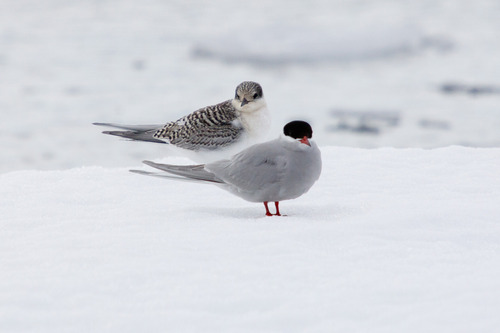
In breeding plumage, the Antarctic tern has a light grey body and wings, a white deeply forked tail, white lower back just above the tail, and white cheeks. It also has a distinctive black cap that extends from the nape down to the bill, and brownish-black eyes. Its bill, legs, and feet are bright red.
Non-Breeding Plumage
In non-breeding plumage, the black cap is reduced to only the area behind the eyes, the underparts become lighter, and the bill turns a dull reddish-black colour.
Juvenile Appearance
Juveniles have yellowish-brown, grey, and white spots on their backs, with a yellowish-brown belly and breast. Juveniles have a dull black bill and dull red legs.
Chick Appearance
Chicks are yellowish-brown with black spots on their heads and backs, have a greyish white belly and a darker throat, and their bill, legs, and feet may be flesh coloured or reddish black.
Arctic Tern Comparison
The Antarctic tern closely resembles the Arctic tern. When migrating Arctic terns arrive in non-breeding plumage, local Antarctic terns are already in breeding plumage. Arctic terns also have shorter legs and more prominent black margins on the outside of their primary feathers.
White-Fronted Tern Comparison
The white-fronted tern is also similar to the Antarctic tern, but can be told apart by the white-fronted tern's larger body size, lighter colours, and longer black bill. Different subspecies of Antarctic tern vary in size and plumage tone, but are often hard to distinguish from one another.
Vocalization Overview
Antarctic terns are quite noisy near their roost sites. Their main call, rendered as "trr-trr-kriah", is given when they are in flight or fishing.
Defensive and Mating Calls
They use a "chrrrr" call to defend their nests against intruders or predators, and produce a higher-pitched call to get the attention of their mates.
Breeding Habitat
The Antarctic tern prefers rocky habitats such as islets, with or without vegetation, and often lives among other seabird species. It usually nests on cliffs, but can also be found on rocky beaches that are inaccessible to cats or rats. It avoids beaches occupied by sea lions, as these animals tend to take over all flat areas.
Non-Breeding Habitat
Outside the breeding season, this tern species seeks out ice edges in Antarctica, and also visits beaches and rocky cliffs of South Africa. It has a large range, and is widely distributed around sub-Antarctic islands of the southern hemisphere and the Antarctic mainland.
Breeding Distribution
Its breeding territory includes the Antarctic continent, Bouvet Island, the French Southern Territories, Saint Helena, Ascension and Tristan da Cunha, South Africa, South Georgia, and the South Sandwich Islands. Recently, some populations have been observed nesting on newly ice-free terrain on the north-eastern Antarctic Peninsula. Each subspecies has specific breeding islands.
Migration Patterns
Unlike the Arctic tern, the Antarctic tern does not undertake a long migration to the opposite pole after breeding. It usually stays close to its breeding islands year-round. However, more southern populations migrate slightly further north for the non-breeding part of the year, and can be found in Uruguay, Argentina, Brazil, Chile, the Falkland Islands, Heard Island, the McDonald Islands, Australia, and New Zealand.
Diet
The Antarctic tern is an opportunistic feeder that mostly eats small fishes, as well as some crustaceans such as Antarctic krill. It usually fishes in groups, forming flocks of up to 100 birds when larger shoals of fish are located.
Foraging Strategies
It fishes by hovering a few meters above the sea. Once prey is spotted, it uses one of two strategies: most of the time it will plunge dive directly and become completely submerged, but if the water is too rough, it will only submerge its bill while remaining in flight.
Foraging Range
It normally forages near shore in the kelp zone. It has also been found foraging in the intertidal zone, scavenging for small crustaceans, polychaetes, and shellfish. During the breeding season, it does not venture very far from its nest.