About Sistrurus miliarius Linnaeus, 1766
General Body Build
Sistrurus miliarius is a small but bulky species.
Typical Adult Length
Adults usually reach a total length including tail of 40–60 cm (16–24 in).
Maximum Reported Length (Official)
The maximum total length ever officially reported is 78.8 cm (31.0 in), per Klauber 1972.
Captive Specimen Length Record
Snellings and Collins (1997) documented a S. m. barbouri specimen measuring 80.3 cm (31.6 in) that had been kept in captivity for over 12 years.
Wild Subspecies Length Record
Gloyd (1940) recorded the largest wild S. m. barbouri he found was 63.8 cm (25.1 in), collected from St. Petersburg, Florida.
Sexual Size Dimorphism Hypothesis
Shine (1978) hypothesized that males may be larger than females in some populations of this species.
Sexual Dimorphism Study Finding
However, a later 1996 study by Bishop et al. found no sexual dimorphism of any sort in a Sistrurus miliarius population from Volusia County, Florida.
Sexual Dimorphism Explanation
It is currently theorized that the general lack of sexual dimorphism in this species occurs because both males and females face the same selective pressures favoring larger body size.
Dorsal Scale Count
At midbody, this species usually has 23 rows of dorsal scales.
Dorsal Spot Pattern
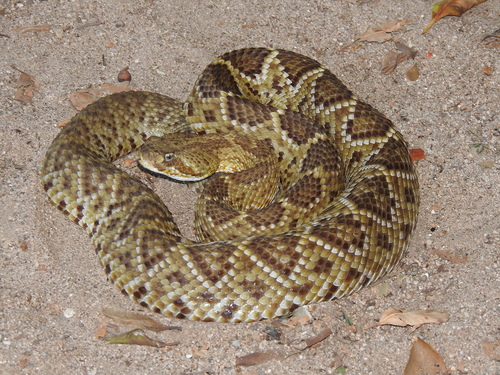
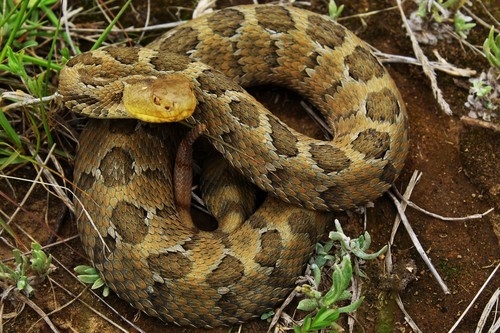
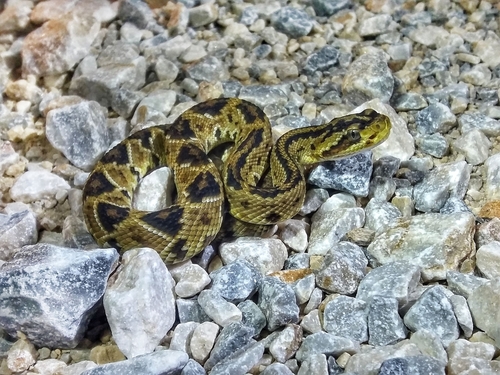
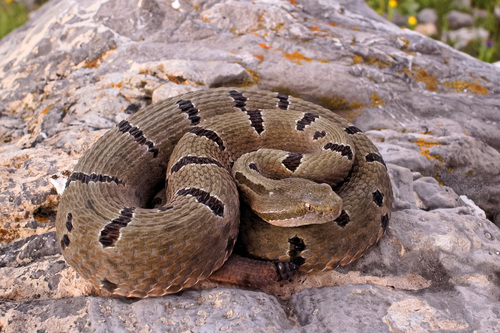
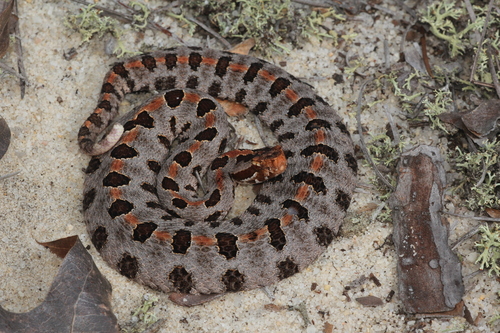
Its dorsal color pattern is made up of a series of oval or nearly circular spots with relatively regular edges.
Flank Spot Characteristics
Spots on the flanks are mostly round, and are not much taller than they are wide.
Ventral Pigmentation Pattern
On the rear part of the belly, pigment is restricted to faint, indistinct blotches that occur in pairs on adjacent scales.
Juvenile Coloration
Juveniles have a color pattern similar to adults, though it may be paler or have more vivid markings, and the tip of the juvenile tail is yellow.
Native Range
Sistrurus miliarius is native to the Southeastern United States.
Geographic Distribution Extent
Its geographic range extends from southern and eastern North Carolina, south through peninsular Florida, and west to eastern Texas and Oklahoma.
Original Type Locality
The originally given type locality for this species is "Carolina".
Restricted Type Locality
In 1953, Schmidt proposed restricting this type locality to "Charleston, South Carolina".
Inhabited Ecosystems
Sistrurus miliarius has been reported to inhabit flatwoods, sandhills, mixed forests, and floodplains, and it can also be found near lakes and marshes.
Habitat Preference
Because this species needs cover, pygmy rattlesnakes may tend to prefer more densely vegetated areas.