About Serranocirrhitus latus Watanabe, 1949
Common Name & Body Depth
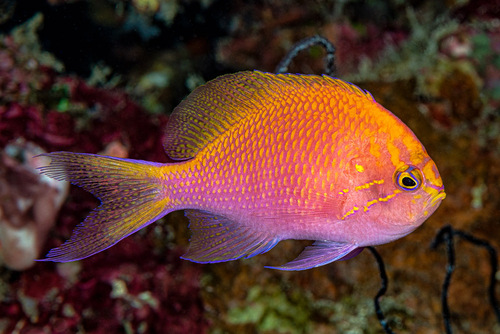
This species, commonly called the hawkfish anthias, has a notably deeper body than other members of the subfamily Anthiinae.
Pectoral Fin Structure
It has elongated pectoral fins that extend to the rear portion of the anal fin.
Body Scale Coloration
The fish's overall body color is pinkish, and each individual scale bears a bright yellow to orange marking.
Head Markings
Two bright yellow stripes radiate out from the back of the eye, and there is an additional yellow spot on the operculum.
Fin Ray Counts
Its dorsal fin has 10 spines and 18–20 soft rays, while the anal fin has 3 spines and 7 soft rays.
Maximum Recorded Length
The maximum recorded total length for this species is 13 centimetres (5.1 inches).
Western Pacific Distribution Range
The hawkfish anthias ranges from southern Japan, specifically the Ryukyu and Izu Islands, and Taiwan, southward to the Great Barrier Reef and Palau.
Extended Distribution Limits
It occurs as far west as the Moluccas and as far east as Tonga.
Habitat Depth Range
This species inhabits inshore waters near coral reefs, at depths between 10 and 70 metres (33 to 230 feet).
Grouping & Shelter Preferences
It may be found alone or in small groups that typically gather close to caves, overhangs, and drop-offs.
Swimming Behavior & Site Fidelity
It is a secretive species that frequently swims upside down beneath overhangs or cave ceilings, and individuals remain faithful to a specific shelter.
Diet Composition
Its diet consists primarily of zooplankton.
Reproductive Biology
Hawkfish anthias are protogynous hermaphrodites: when a male in a loose aggregation dies or disappears, the dominant female changes sex to become the new male.