About Centropristis striata (Linnaeus, 1758)
Size
Centropristis striata (Linnaeus, 1758), commonly called black sea bass, reaches a maximum total length of 66 centimetres (26 in), and individuals most commonly grow to around 30 centimetres (12 in). The maximum published weight for this species is 4.1 kilograms (9.0 lb).
Body Shape
Black sea bass have an oblong, laterally compressed body with a large mouth that extends to below the middle of the eye.
Teeth and Covers
The jaw holds bands of teeth; the front of the mouth’s roof has a triangular patch of teeth, with additional teeth along the sides of this area. The preopercle has an evenly rounded margin with fine serrations, and the gill cover bears three flat spines.
Dorsal and Anal Fins
The dorsal fin has 10 spines (the front spines are longer than the rearmost) and 11 soft rays, with deep notches in the membranes between the dorsal spines. The anal fin has three spines and seven soft rays.
Caudal Fin
Long, pointed upper, middle, and lower rays on the caudal fin create three distinct lobes.
Colour Pattern
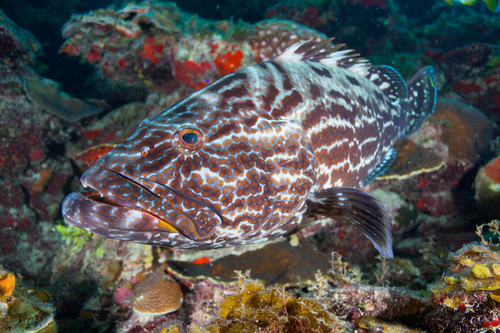
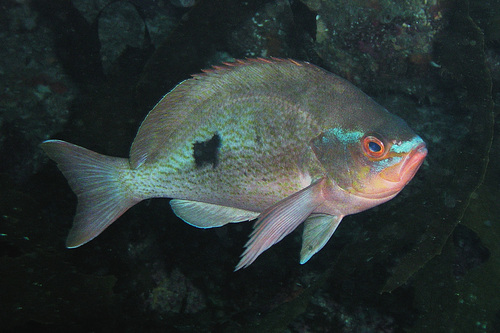
The typical colour pattern is smoky grey, dusky brown, or blue-black on the back and upper body, fading toward the underside. Each scale has a pale blue to white spot in its center, and these spots form longitudinal stripes along the back and flanks.
Fin Markings
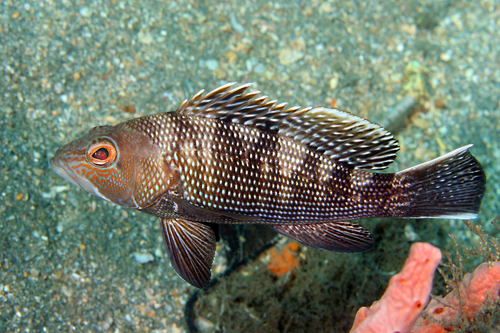
The dorsal fin has a pattern of white spots and bands running along its length. Flanks are often mottled, or marked with dark and light vertical barring.
Breeding Males
During the breeding season, males develop bright fluorescent blue and green colouration around the eyes and nape, along with a head hump.
Females and Juveniles
Females are paler and duller, with brownish or blue-grey colouration. Juveniles have four distinct colour phases: an overall light grey phase with small dark spots, a dark phase with pale white spots, a striped phase with a longitudinal dark stripe, and a barred phase with six vertical bars.
Distribution
This species is distributed in the western Atlantic Ocean, ranging from Nova Scotia south along the eastern North American coast to the Florida Keys, and extending into the Gulf of Mexico as far west as Louisiana, just west of the Mississippi Delta.
Shallow Habitat
Black sea bass are most commonly found around rock jetties and over rocky substrates in shallow water, but have also been recorded in deeper offshore waters up to 130 metres (430 ft) deep.
Behaviour
They spend most of their time near the seabed, frequently aggregating around bottom features like rock piles, wrecks, and man-made structures. They are often observed resting in either a head-down or head-up position. The dorsal fin is normally folded down, but will be raised and spread as an aggressive signal to other members of the species. Juveniles stay in protected estuarine waters, where they occur around man-made structures, wrecks, and over shell substrates.
Lifespan
Females of this species live to around 8 years of age, while males can live to 12 years. Black sea bass are slow growing, and reach sexual maturity between one and three years old.
Sex Change
They are protogynous hermaphrodites: most individuals begin life as females, then change sex to become males. The trigger for this sex change is not known, but it is thought that the largest females change sex in response to a shortage of males within a spawning group.
Spawning
Spawning occurs from January to July. Smaller females produce as few as 30,000 eggs, while larger females can produce up to 500,000 eggs. The eggs are pelagic, with a diameter of 0.9–1.0 mm.
Larvae
They hatch 75 hours after being laid in water at 16 °C (61 °F). Larvae remain pelagic until they grow to around 13 millimetres (0.51 in) long, when they shift to a demersal or estuarine lifestyle.
Diet
This is a predatory species with a broad diet that includes crabs, shrimps, barnacles, worms, tunicates, small fish, and bivalves.
Predators
Black sea bass are preyed on by larger fish; confirmed predators include monkfish (Lophius americanus), spotted hake (Urophycis regia), summer flounder (Paralichthys dentatus), striped bass (Morone saxatilis), bluefish (Pomatomus saltatrix), weakfish (Cynoscion regalis), little skate (Leucoraja erinacea), spiny dogfish (Squalus acanthias), bignose shark (Carcharhinus altimus), and dusky shark (Carcharhinus obscurus).