About Epinephelus rivulatus (Valenciennes, 1830)
Body Proportions
Epinephelus rivulatus (Valenciennes, 1830) has a body whose standard length is 2.7 to 3.2 times its depth.
Head Morphology
The dorsal profile of the head is convex, and the intraorbital region is flat. The preopercle is angular, with 1 or 2 small spines on the anterior side of the angle, while the gill cover is convex.
Fin Ray Counts
The dorsal fin has 11 spines and 16-18 soft rays, and the anal fin has 3 spines and 8 soft rays. The membrane between the spines is distinctly notched.
Caudal Fin Shape
The caudal fin is rounded.
Body Coloration
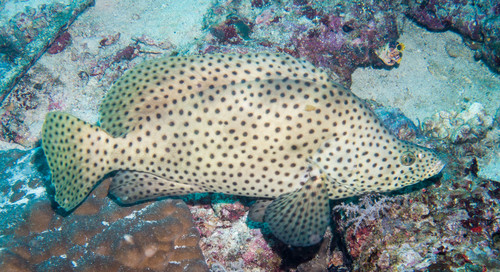
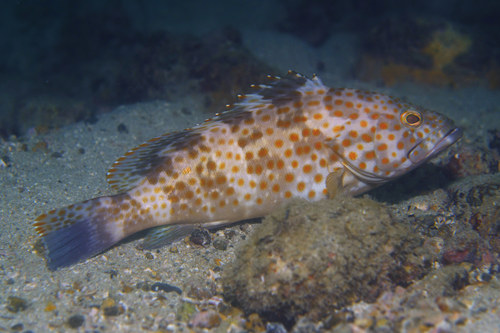
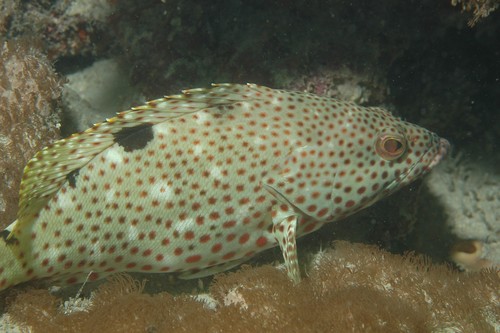
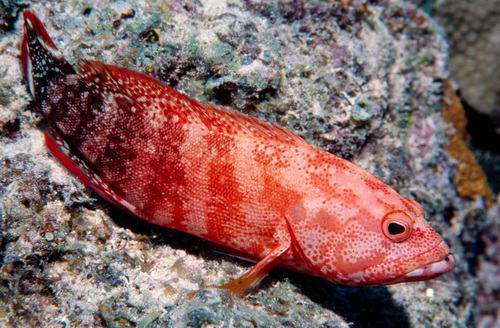
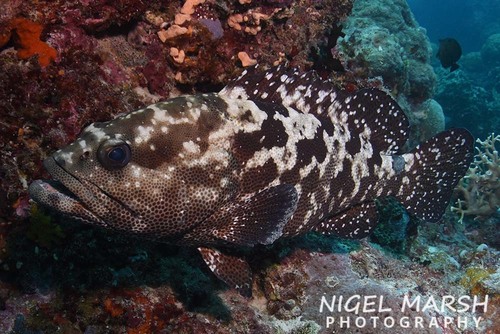
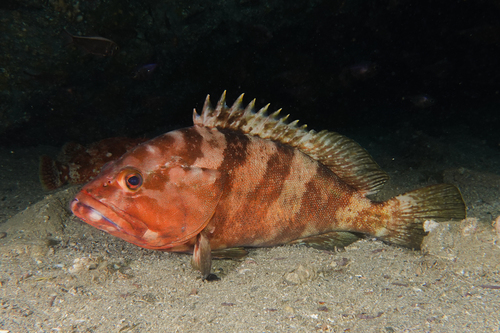
The body color ranges from reddish to greenish-brown, and each body scale has a small white or pale blue spot. Sometimes 4 irregular dark vertical bars are visible, with a fifth dark bar present on the caudal peduncle.
Head Coloration
The head is dark brown to pale reddish, marked with pale blue vermiculations, and has white spots on the lower jaw and upper lip.
Fin Coloration
The pectoral fin is dusky, with a dark red or reddish-brown blotch at its base. The remaining fins are greenish-brown or greyish-brown, marked with dark mottling.
Size and Weight
This species reaches a maximum total length of 45 cm (18 in), and a maximum weight of 1.4 kg (3.1 lb).
Overall Distribution Range
Epinephelus rivulatus has a wide distribution across the Indo-West Pacific. It occurs from the east African coast, ranging from the Gulf of Aden south to South Africa, then east to New Caledonia, north to the Ogasawara Islands of southern Japan, and south to Australia.
New Zealand Distribution
Its range includes northern New Zealand; it was first recorded from the Kermadec Islands Marine Reserve north of New Zealand in 2015, after researchers examined hundreds of hours of unused documentary film footage.
Indian Ocean Distribution
It is also found on the Indian Ocean islands of the Chagos, Comoros, Madagascar, Mauritius and the Seychelles, and does not occur in Fiji, the Red Sea or the Persian Gulf.
Habitat Types
Epinephelus rivulatus lives on coral reefs, over areas with rocky substrates, algal flats and seagrass beds.
Depth Range
It occurs at depths from 1 to 150 metres (3.3 to 492.1 ft).
Diet
It feeds on fishes and crustaceans.
Reproductive Mode
This species is a protogynous hermaphrodite.
Female Sexual Maturity
Sexually mature females have fork lengths between 144 to 350 millimetres (5.7 to 13.8 in), with half of all females reaching sexual maturity at a fork length of 194 millimetres (7.6 in).
Male Size Range
Males are larger than females, with fork lengths ranging from 221 to 381 millimetres (8.7 to 15.0 in).
Sex Ratio
While these size ranges vary between sites, sex ratios are consistent across sites, with roughly 5.5 females for every one male.
Reproductive Period
Off the coast of Western Australia, most females are reproductively active between July and December, which coincides with relatively cool water temperatures and increasing daylight hours.
Spawning Frequency
Spawning occurs periodically, and each female is able to spawn at least twice over periods of two or three consecutive days.
Spawning Behavior
This species forms aggregations for spawning.
Parasite Host Record
It is the only known host of the gill parasite Pseudorhabdosynochus inversus.