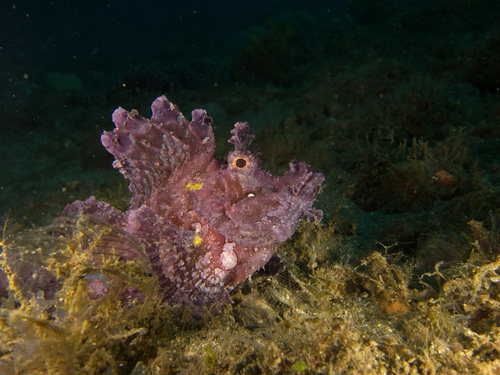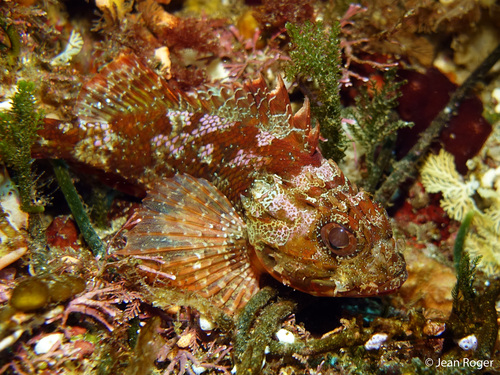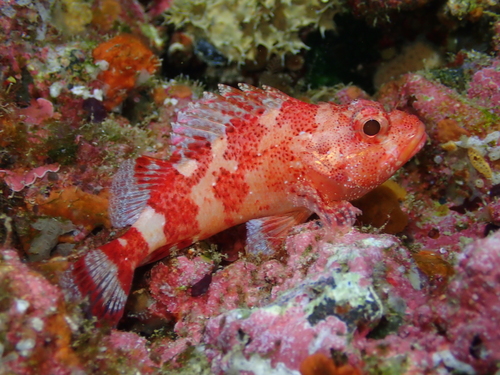
About Scorpaena maderensis Valenciennes, 1833
Size
The Madeira rockfish (Scorpaena maderensis Valenciennes, 1833) typically grows between 4.8 cm (1.89 in) and 13.1 cm (5.16 in) in length, and weighs between 1.7 g and 48.1 g. Males of this species are larger than females in both length and weight.
Sexual Dimorphism
Females reach their maximum size faster, and live longer than males. The maximum recorded length is approximately 15 cm (5.91 in) for males and 9.0 cm (3.54 in) for females.
Morphological Traits
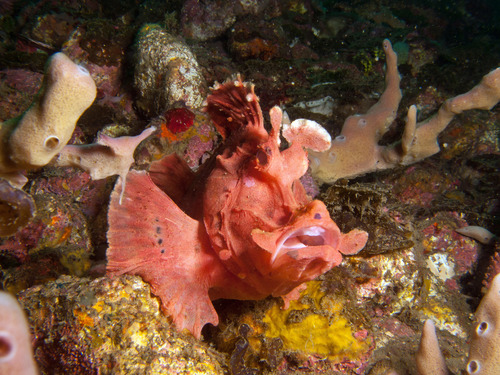
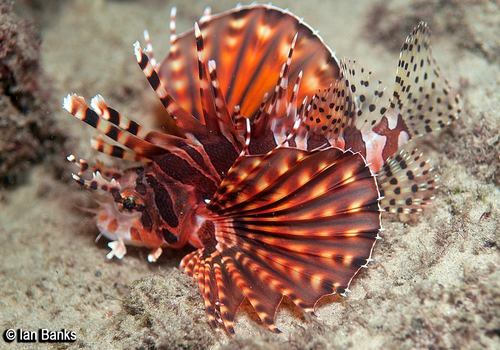
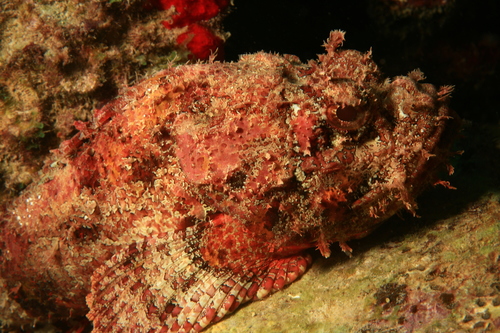
Like other species in the genus Scorpaena, S. maderensis has traits including spiny fins and a reddish-brown splotched coloration, but there is a lack of sufficient specific information about the species. One well-documented shared trait is the presence of venomous spines, which carry venom in an anterolateral glandular groove.
Venom Effects
Venom from fish in the family Scorpaenidae causes a range of health issues, and can be fatal if left untreated.
Distribution
The Madeira rockfish inhabits littoral rocky coastal waters of northwestern Africa, the Mediterranean Sea, and islands in the eastern Atlantic.
Benthic Behavior
S. maderensis is a cryptobenthic fish: this means it is benthic, living in or on the seafloor, and cryptic, hiding in crevices or using camouflage. It resides in the cracks and crevices of rocky bottoms, where it hunts for prey and hides from predators.
Abundance Data Gap
It is difficult to assess the overall abundance of S. maderensis across the entire Mediterranean Sea because of limited data.
Local Abundance
However, extensive research conducted in the Cyclops Protected Marine Area off the coast of Sicily found that S. maderensis is the dominant fish species in this location.
Depth Range Conflicts
There is conflicting research about the depth range S. maderensis prefers: some studies report a preferred depth of 20 to 40 meters, while others find the species occurs mostly above 7 meters, with populations dropping off at 13 meters. This discrepancy stems from a lack of collected data on S. maderensis, which makes it hard to confirm a specific, consistent depth range for the species.