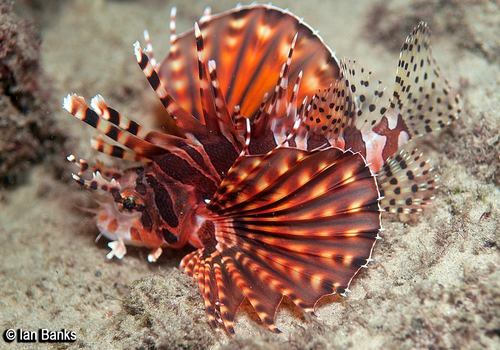
About Rhinopias frondosa (Günther, 1892)
Common Name and Body Covering
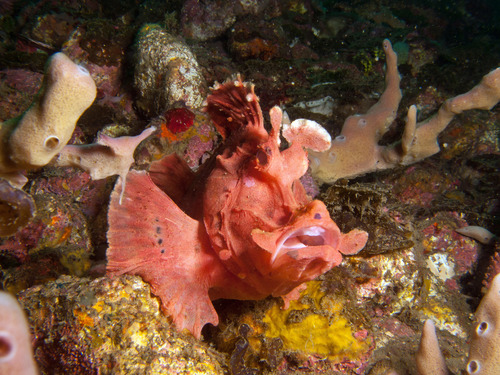
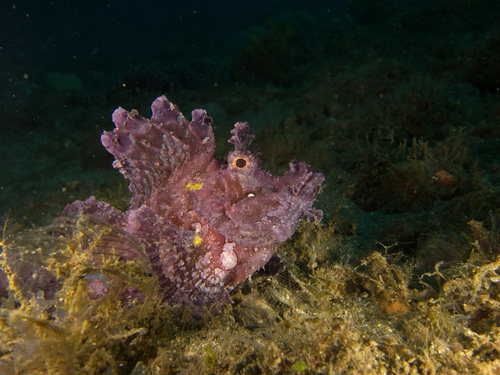
Rhinopias frondosa, commonly called the weedy scorpionfish, has a strongly compressed body covered in weed-like tentacles.
Fin Ray Counts
Its dorsal fin has 12 spines and 9 soft rays, while its anal fin has 3 spines and 5 soft rays.
Dorsal Fin Spots
The soft-rayed section of the dorsal fin bears two small black spots, each with a diameter smaller than the diameter of the fish's orbit.
Head Tentacle Placement
Fleshy tentacles grow on the supraocular and posterior lacrimal spines.
Soft Fin Edge Morphology
The distal edges of the soft-rayed sections of the dorsal, pelvic, anal, and caudal fins either have no notches or only very weak notches.
Caudal Fin Ray Structure
The tip of each fin ray in the caudal fin is split into four branches.
Dorsal Spine Flexibility
The dorsal fin spines are relatively flexible, and their tips bend easily even when very light pressure is applied.
Head Bone Bumps
The lateral surface of the lacrimal bone is usually smooth or has a single bump, and the suborbital ridge typically has 3 bumps.
Body and Jaw Tentacles
There are between 9 and 24 tentacles on the lower jaw; tentacles are also present below the eyes, and tentacles cover the fish's flanks.
Spiny Dorsal Fin Membranes
The fin membranes of the spiny section of the dorsal fin have distinct incisions.
Body Coloration Pattern
The body color of this species varies widely, but all individuals share a distinctive pattern: numerous separate circular spots with dark margins, where the center of each spot matches the background body color.
Maximum Length
The maximum known total length this species reaches is 23 cm (9.1 in).
Geographic Range
The weedy scorpionfish lives in the Indian Ocean and Western Pacific Ocean, ranging from Japan to Australia, and from South Africa to the Caroline Islands.
Depth Range
It occurs at depths between 13 and 90 meters.