About Salamandra corsica Savi, 1838
Common Name & Base Coloration
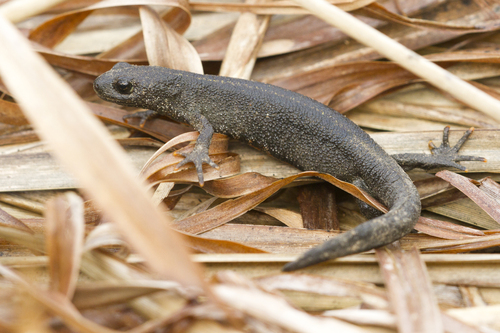
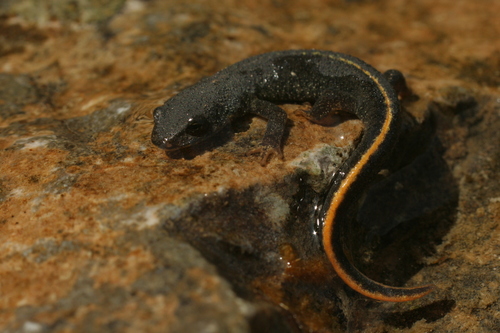
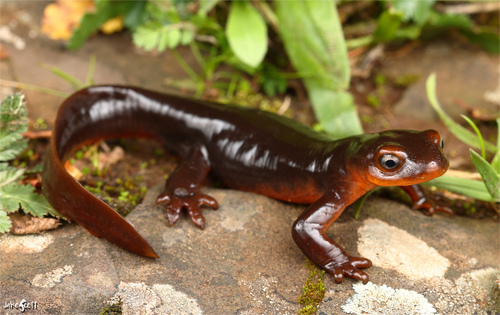
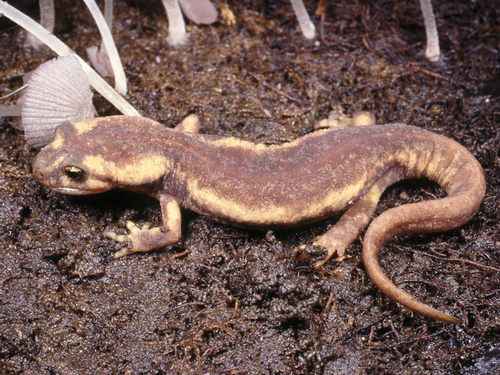
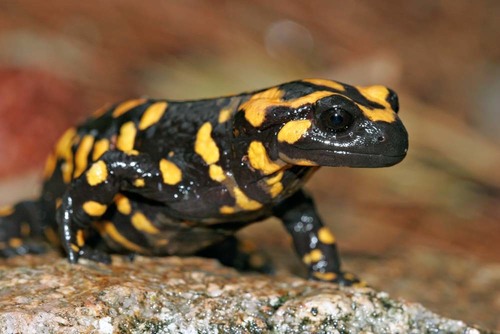
Salamandra corsica, the Corsican fire salamander, are glossy black salamanders with yellow splotches on their upper back, with adults reaching between 120 and 300 mm in total length.
Sexual Size Dimorphism
Males are generally smaller than females.
Head Shape
Their heads are wider than they are long, with a rounded shape.
Gland Structure
This species has bright yellow paratoid glands, two parallel lines of poison glands running along its ventral sides, and two irregular rows of glands running down the tail.
Extremity Shape
The snout, toes, and tip of the tail are all blunt and rounded.
Male Cloacal Morphology
Males have prominent cloacas, with a single longitudinal fold forming the cloacal opening.
Costal Grooves
Clear costal grooves run along the ventral sides of Corsican fire salamanders.
Skin and Paratoid Gland Comparison
These salamanders have smooth, shiny skin; their paratoid glands are easily visible but reduced in size compared to other species in the genus Salamandra.
Primary Habitat Type
The Corsican fire salamander mainly inhabits deciduous mountain forests of Corsica.
Low Elevation Occurrence & Oak Habitat
While individuals have been found near sea level on the west coast at Calanques de Piana, they generally occupy forests containing deciduous oaks including sessile oak and downy oak, as well as sweet chestnut gardens near human settlements.
Pine Forest Habitat
They also live in forests of maritime pine and Corsican black pine (Pinus nigra subsp. salzmannii var. corsicana).
Undesirable Vegetation Types
Dense growths of bracken fern (Pteridium aquilinum), tree heath, and other shrubby vegetation can reduce Corsican fire salamander populations, as can evergreen sclerophyllous woods such as holly oak forests, due to their lower total precipitation.
Beech Forest Occupation
Beech forests are occupied in Castagniccia and the south of Corsica, where beech forms dense azonal forests and does not occur primarily at the upper tree line as it does in Corsica's western mountain ranges.
Preferred Elevation Range
The mid-level elevations of Corsica's mountains are the preferred habitat for this species, due to their consistent humidity and moderate temperatures.
Stream Flow Requirement for Larvae
Steady flow of water in streams descending from mountain summits supports successful larval development through the hot summer.
Larval Birth Timing
Larvae are born after snow melts, when streams are once again safe for newborn larvae.
Adult Shelter Habitat
Rocky stone runs in this habitat also provide preferred hiding places for adult salamanders to escape daylight and summer drought.
Viviparity Observation
German herpetologist Robert Mertens discovered unexpected reproductive variation in this species: a pregnant Corsican fire salamander he collected in the Restonica Valley gave birth to four offspring that lacked gills and already had the species' characteristic black and yellow adult patterning.
Aquatic Larvae Morphology
At the same time, he found normally developing aquatic larvae, which have three characteristic feathery external gills on each side of the head and camouflage coloration that blends into pond substrates.
Viviparity Precedents in Related Species
The ability to produce fully developed young (viviparity) is already known from the northwestern Spanish subspecies of fire salamander S. s. bernardezi (the Asturian fire salamander), and from the alpine salamander S. atra of the central and eastern Alps.
Reproductive Adaptation Explanation
This reproductive mode in Corsican fire salamanders is interpreted as a local adaptation to xerothermic climate conditions and a lack of permanent ponds and brooks.