About Euproctus montanus (Savi, 1838)
Species Size Comparison
The Corsican brook salamander (Euproctus montanus) is smaller than its close relatives, including the Sardinian brook salamander (Euproctus platycephalus). It can reach a maximum length of around 13 cm (5 in), with a more typical adult size of 10 cm (4 in).
Body and Tail Structure
It has a long head with a rounded snout, and a tail that is oval in cross-section and equal in length to the rest of its body. The parotoid glands on the sides of its neck are clearly visible.
Sexual Dimorphism
Males have spurs on their hind legs and a backward-pointing conical cloaca, while females have a cloaca with a ventral opening.
Skin Texture
The salamander’s skin is smooth when it lives in water, but becomes more granular when it is on land.
Dorsal Coloration
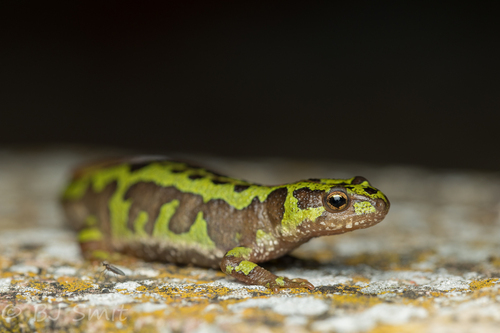
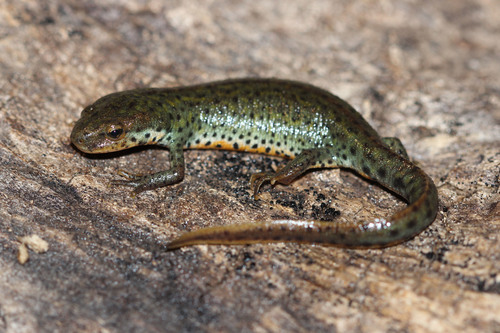
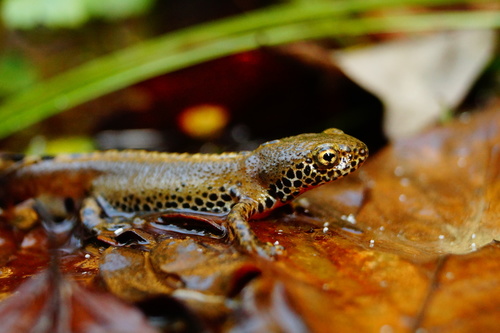
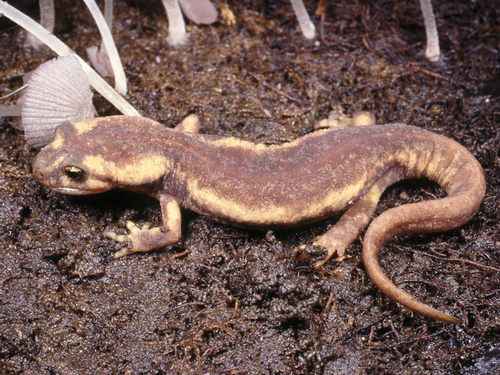
Its base color is brown or olive, and it sometimes has mottling in orange, red, or darker brown, especially near the spine.
Ventral Coloration
Its underside is paler and fairly uniformly colored, sometimes with small white flecks, and the throat has no spots.
Sympatric Species Distinction
The only other salamander found alongside this species on Corsica is the Corsican fire salamander (Salamandra corsica), which is easily distinguished by its distinctive black and yellow patterning.
Endemic Range
This salamander is endemic to the island of Corsica.
Altitudinal Distribution
It does not occur in eastern lowland areas or along most of the Corsican coast, but can be found at altitudes from sea level up to 2,250 metres (7,382 ft), and is most common between 600 and 1,500 m (2,000 to 4,900 ft).
Aquatic Habitat
It is primarily aquatic, inhabiting lakes, ponds, and slow-moving sections of streams, where it often hides under stones.
Terrestrial Habitat
When it moves onto land, it does not travel far from water, and lives in maquis shrubland and woodlands, where it can be found in the undergrowth or under fallen logs and rocks.