About Calotriton asper (Dugès, 1852)
Common Name & Size
Calotriton asper, commonly known as the Pyrenean brook salamander, reaches a total length of about 16 cm (6.3 in), with half of this length consisting of a laterally flattened tail. Females are typically larger than males.
Body & Head Structure
This species has a sturdy body, a flattened head, small eyes, and short limbs. It lacks parotoid glands, and its skin is covered in small, rough tubercles.
Dorsal Coloration
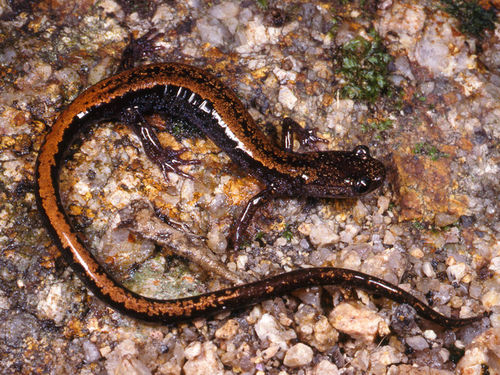
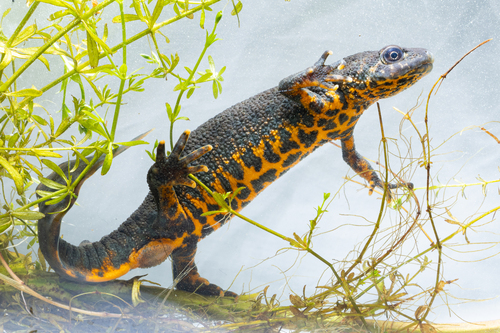
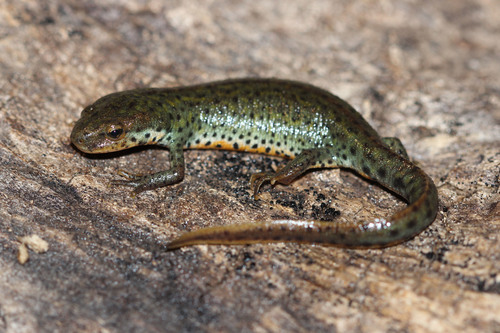
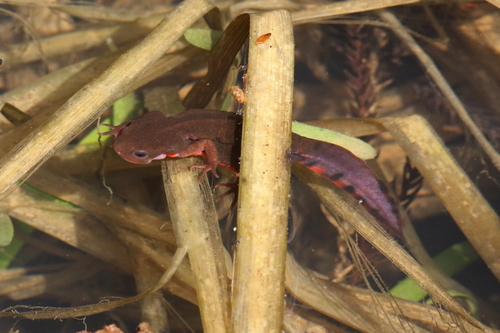
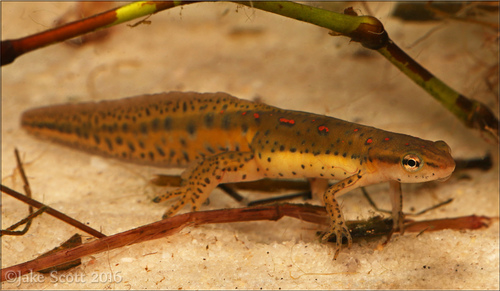
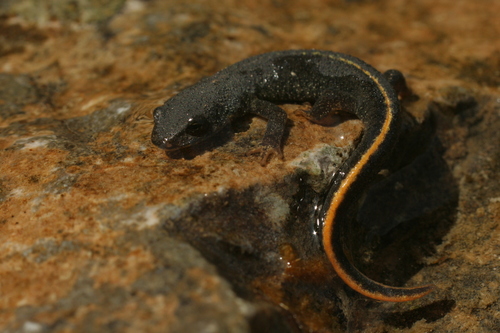
Its coloration is highly variable: the upper surface is usually some shade of olive, grey, charcoal, or muddy brown, sometimes mottled with ochre, with an intermittent yellowish stripe running along the spine.
Ventral Coloration
The underside has a row of dark splotches along each side, and its central region is red, orange, or yellow.
Sexual Dimorphism
Males have a rounded cloacal swelling, while females have a conical cloacal swelling.
Distribution & Altitude
The Pyrenean brook salamander is endemic to the Pyrenees and nearby surrounding mountains, occurring at altitudes between 700 and 2,500 metres (2,300 to 8,200 ft).
Habitat Preference
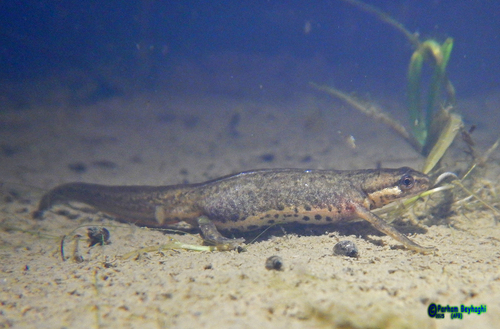
It is a mostly aquatic species that most often inhabits slow-moving streams and shallow mountain lakes. It prefers water cooler than 15 °C (59 °F) that has scarce vegetation and rocky or pebbly bottoms.
Cave Dwelling & Breeding
Some individual Pyrenean brook salamanders live entirely within caves, where they breed over an extended period throughout the year, due to the absence of day length stimulation for breeding.