About Rynchops albicollis Swainson, 1838
Taxonomy and Naming
This species has the scientific name Rynchops albicollis Swainson, 1838, historically also known as the Indian scissors-bill.
Breeding Adult Plumage
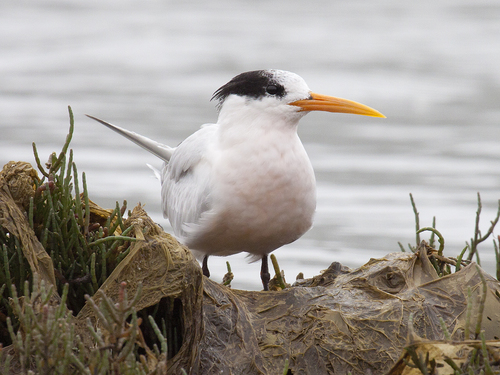
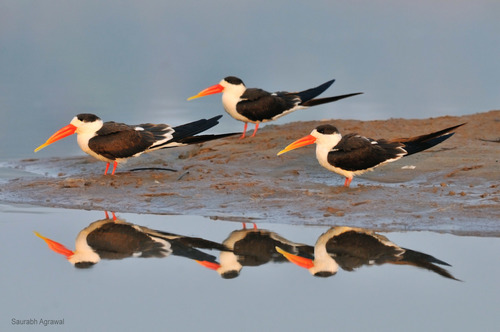
Adult breeding birds have a black cap that leaves the forehead and nape white, a white body, and a contrasting orange long thick bill with a yellow tip.
Mandible Structure
Like other skimmers, this species has a longer lower mandible than upper mandible; the knife-like lower bill is flexible with a truncated tip, and the upper mandible can move considerably.
Bill Development
Young birds have normal-appearing bills, and the lower mandible grows longer with age.
Body Plumage
The upper body is dark black, and the underparts are white.
Wing Structure and Appearance
Long, pointed wings have a white trailing edge, and the bird has a tern-like appearance.
Size Measurements
It measures 40–43 cm in length with a 108 cm wingspan.
Tail Characteristics
The short, forked tail is white with blackish central feathers.
Leg and Foot Color
Legs and feet are red.
Non-breeding Adult Plumage
Non-breeding adults are duller and browner than breeding birds.
Juvenile Upperpart Plumage
Juveniles are grey-brown on their upperparts, with pale fringes on back and wing feathers.
Juvenile Head and Bill Features
Juveniles have more white on the head than adults, and an orange-brown bill with a dark tip.
Vocalization
This bird makes a high, nasal screaming kyap-kyap call, but is usually very silent.
Similar Species Distinction
It can be distinguished from similar species: the American black skimmer is larger and has a black-tipped bill, the African skimmer is smaller, has more black in the tail, and has no white collar.
General Habitat
This bird inhabits large rivers, lakes, swamps, and coastal wetlands such as estuaries.
Freshwater Habitat Preference
It is most common in freshwater habitats, especially during the breeding season.
Breeding Colony Locations
Breeding colonies form on islands or sandy spits, usually within rivers.
Documented Breeding Sites
Documented breeding locations include the Chambal river area (an important habitat for gharials, which also nest on sand banks here), and the Mahanadi river banks at the Munduli barrage, Chandaka Wildlife Division in Cuttack.
Range Fragmentation Status
In recent decades, the species' range has become increasingly fragmented.
Current Core Range
Currently, it can still be found in parts of Pakistan in the Indus river system of Kashmir, northern and central India along the Ganges, Bangladesh, and Burma.
Extinct Former Range
It formerly occurred in Laos, Cambodia, and Vietnam.
Non-breeding Visitor Range
It is a scarce non-breeding visitor to Nepal.
Vagrant Occurrence Records
It has occurred as a vagrant in Oman and central Thailand, with old records from Iran and China.
Current Stronghold Regions
Today, the species' last strongholds are India and Bangladesh.
Winter Distribution
In winter, the species is more widespread, found in coastal estuaries of western and eastern India; on the western coast it occurs as far south as Karwar, and on the eastern coast it occurs as far south as Chennai and Pondicherry.