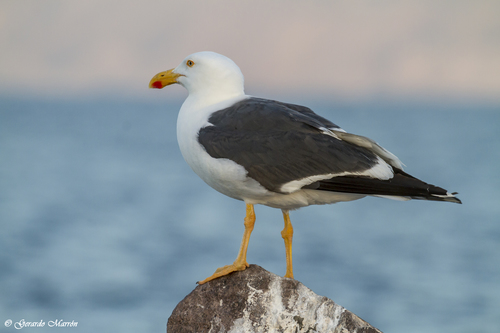
About Larus canus Linnaeus, 1758
Scientific Name
Larus canus Linnaeus, 1758
Description
Adult Size
Adult common gulls are 40–46 cm (16–18 in) long with a 100–115 cm (39–45 in) wingspan, noticeably smaller than herring gulls and slightly smaller than ring-billed gulls.
Breeding Plumage
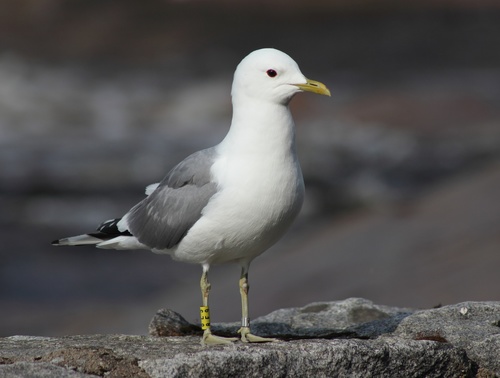
They are further distinguished from ring-billed gulls by a shorter, more tapered bill that is a greener shade of yellow and unmarked during the breeding season. Their upper body is grey and underbody is white. Legs are yellow in the breeding season and duller in winter.
Winter Plumage
In winter, their head is streaked grey, and the bill often has a poorly defined blackish band near the tip that is sometimes clear enough to cause confusion with ring-billed gulls. They have black wingtips with large white "mirrors" on the outer primaries p9 and p10, and these mirrors are smaller than those found on short-billed gulls.
Juvenile Plumage
Young birds have scaly black-brown upperparts, a neat wing pattern, and pink legs that turn greyish in the second year before becoming yellow. By the first winter, the head and belly are white with fine streaks, and greyish feathers grow on the saddle.
Maturation and Vocalization
Common gulls take three years to reach maturity, and up to four years for the Kamchatka subspecies. Their call is a high-pitched "laughing" cry.
Distribution
Breeding and Winter Range
The common gull breeds in the northern Palearctic from Iceland east to northeast Siberia. It is mainly migratory and winters in Europe, the Mediterranean, Black and Caspian seas, Persian Gulf, as well as the Sea of Okhotsk, Japan, Korean Peninsula, and southeast China.
North American Occurrence
It occurs as a scarce winter visitor to coastal eastern Canada and a vagrant to the northeastern US. The Kamchatka gull is occasionally seen in northwestern North America mainly in spring, and there is one autumn record of it in Newfoundland.
Food and feeding
Diet
Like most gulls, common gulls are omnivores that scavenge and hunt small prey.
Global Population
The global population of common gulls is estimated to be around one million pairs. They are most numerous in Europe, which holds over half, possibly as much as 80–90%, of the global population.
Related Species Population
By contrast, the short-billed gull population in Alaska numbers only around 10,000 pairs.