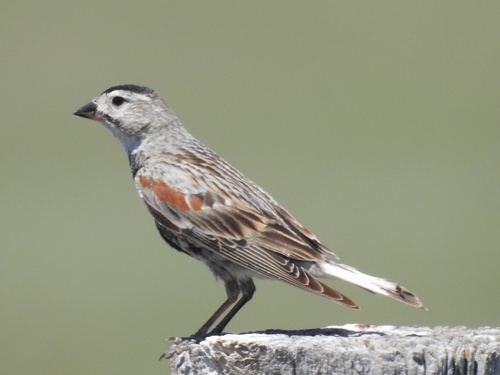
About Rhynchophanes mccownii (Lawrence, 1851)
Scientific Name and Size
The thick-billed longspur, scientific name Rhynchophanes mccownii (Lawrence, 1851), is approximately 15 cm (5.9 in) long, with a 28 cm (11 in) wingspan and an average weight of around 25 g (0.88 oz).
General Morphology
It has a large cone-shaped bill, a streaked back, a rust-coloured shoulder, and a white tail with a dark tip.
Breeding Male Plumage
In breeding plumage, males have a white throat and underparts, a grey face and nape, and a black crown.
Breeding Female Plumage
Breeding females are mostly grey, with a pale bill, and rusty-tinged median coverts and scapulars.
Non-breeding Male Plumage
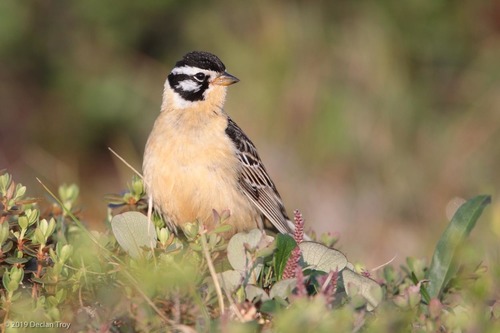
Non-breeding males are similar in appearance to breeding females, but their crowns are spotted rather than streaked, and they have more chestnut colouring on their median coverts and scapulars.
Juvenile Plumage
Juveniles are only seen briefly in late summer; they have more uniformly sandy colouration, a streaked upper breast, and a white belly.
Breeding Range
Thick-billed longspurs breed in the northwestern Great Plains states of the United States and the southern Prairie Provinces of Canada.
Breeding Habitat
They favour sparsely vegetated habitat in semi-arid shortgrass steppes, which are made up of a mix of perennial shortgrasses and cacti.
Breeding Range Decline
The species' breeding range has been drastically reduced.
Historical Breeding Range
Historically, the breeding range extended further south into Oklahoma, and east into Minnesota and Manitoba.
Non-breeding Range
During the non-breeding season, their range extends from southern Oklahoma through Texas to Northern Mexico.
Non-breeding Habitat
In this non-breeding range, they prefer open, sparsely vegetated habitats including shortgrass prairie, plowed fields, grazed pastures, and dried lake beds.