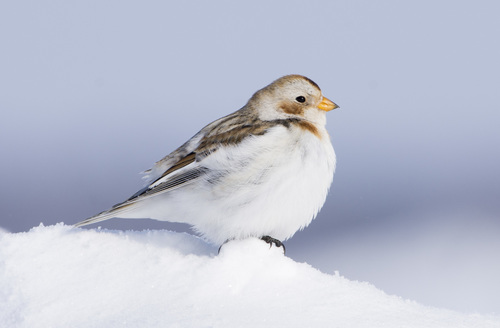
About Plectrophenax nivalis (Linnaeus, 1758)
Common Name and Taxonomic Classification
Plectrophenax nivalis, commonly known as the snow bunting, is a medium-sized sexually dimorphic passerine bird.
Locomotion
It is ground-dwelling, able to walk, run, and hop when necessary.
Size Measurements
For a bunting, it is fairly large with long wings: it measures around 15 cm in length, has a wingspan of 32–38 cm (13–15 in), and weighs 30 to 40 grams.
Bill Appearance
Its bill is normally yellow with a black tip, though breeding summer males have an entirely black bill.
General Plumage Pattern
It has white plumage on its underside, while its wings and back feature a mix of black and white patterning.
Sexual Plumage Dimorphism
Males and females have different plumage. During the breeding season, males are mostly white with black wingtips and a black back; females also have black wingtips, but their back black feathers are fringed with brown.
Winter Plumage
In winter, both sexes have broad orangey-brown fringes on all back feathers.
Breeding Plumage Acquisition
Unlike many other passerine birds, snow buntings do not moult to gain their breeding plumage in spring. Instead, their bright breeding colors emerge as the brown winter fringes wear away, revealing the solid black feather centers.
Cold Adaptation Feature
Unlike most passerines, this species has feathered tarsi, an adaptation to its harsh cold Arctic environment.
Northern Winter Range Extremity
No other passerine bird can winter as far north as the snow bunting, with the only exception being the common raven.
Similar Species: McKay's Bunting
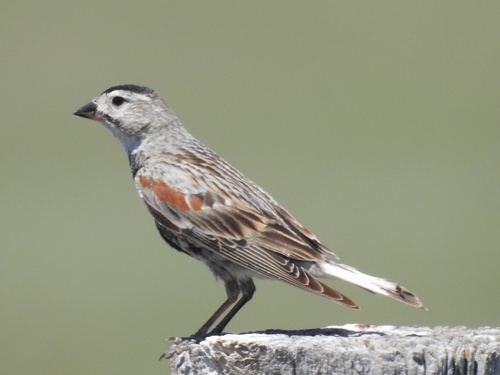
Snow buntings are easily confused with McKay's bunting, due to their similar plumage and the fact that the two species form hybrids.
Similar Species: Lapland Longspur Appearance
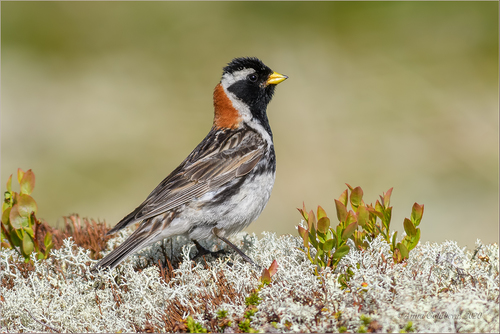
They may also be confused with the Lapland longspur, which differs mainly from the snow bunting in having very little white on its wings.
Similar Species: Lapland Longspur Call Comparison
While their calls are similar, the snow bunting's call has a more 'liquid' rippling tone, while the Lapland longspur's call is drier and more rattling.
Similar Species: Horned Lark Comparison
The snow bunting is sometimes found alongside the horned lark, but the horned lark has a distinctive black-and-yellow head pattern, a longer partly black tail, and no white on its wings.
General Breeding Habitat
The snow bunting inhabits very high latitude Arctic tundra. It has no known northern limit to its range, while its southern range is limited by daylight duration, which affects the species' reproductive activity.
Global Breeding Distribution
It occurs in high Arctic tundra across North America, Ellesmere Island, Iceland, the higher mountains of Scotland, Norway, Russia, North Greenland, Siberia, Novaya Zemlya, and Franz Josef Land.
Winter Distribution
In winter, this migratory species travels to the circumglobal northern temperate zone, including southern Canada, the northern United States, the coasts and plains of northern Europe (including Great Britain, the Netherlands, Germany, Poland, and Ukraine), and eastward to central Asia.
Historical Distribution
During the last ice age, the snow bunting was widespread across continental Europe.
Breeding Season Habitat Preferences
During the breeding season, snow buntings seek out rocky Arctic habitats. Because tundra vegetation is low-growing, adult snow buntings and their nestlings are exposed to predators.
Nest Site Selection
To improve offspring survival, the species nests inside cavities to protect nestlings from threats. Breeding snow buntings also prefer habitats with abundant vegetation, such as wet sedge meadows and areas with plenty of dryas and lichens.
Winter Habitat and Foraging
In winter, they occupy open habitats including farms, barren fields, and lakeshores, where they feed on seeds from the ground.
Non-breeding Diet
From fall through spring, the snow bunting eats seeds from a variety of weeds including knotweed, ragweed, amaranth, goosefoot, aster, and goldenrod, as well as various grass seeds. During this season, it forages in snow to collect seeds from lower plant stems.
Summer Adult Diet
In summer, its diet includes seeds from crowberry, bilberry, bistort, dock, poppy, and purple saxifrage, plus invertebrates such as butterflies, true bugs, flies, wasps, and spiders.
Nestling Diet
Nestlings are fed exclusively on invertebrates.
Foraging Behavior
Snow buntings hunt basking spiders by moving rocks around to disturb them, and will less commonly attempt to catch flying invertebrates in mid-air.