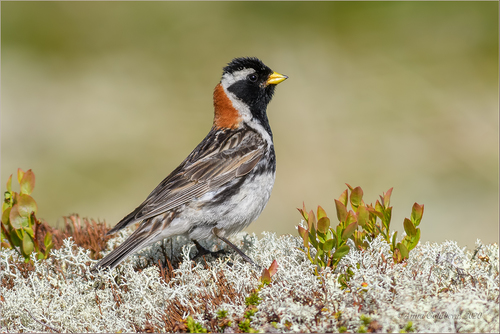
About Calcarius lapponicus (Linnaeus, 1758)
Species Overview
The Lapland longspur, with the scientific name Calcarius lapponicus (Linnaeus, 1758), is a robust bird with a thick yellow bill adapted for eating seeds.
Breeding Male Plumage
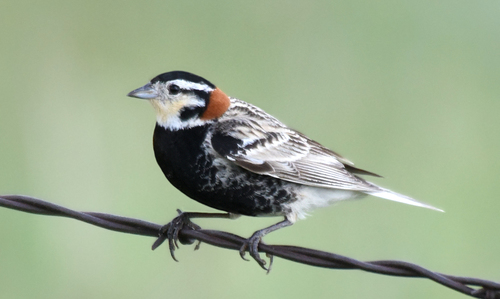
Breeding season (summer) males have a black head and throat, a white eyestripe, a chestnut nape, white underparts, and a heavily streaked black-grey back.
Non-Breeding Plumage
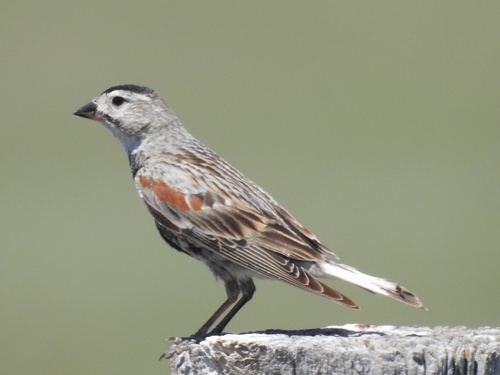
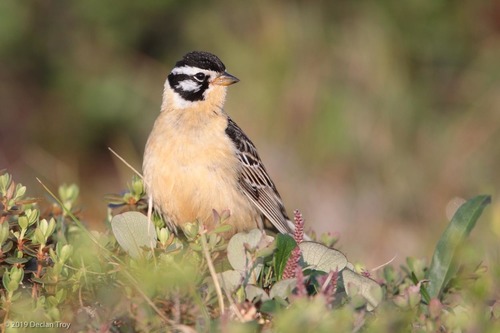
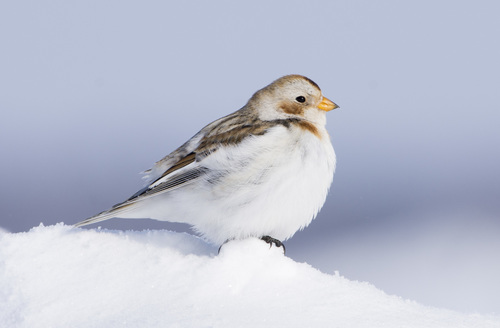
All other plumage variations have a plainer orange-brown head, a browner back, and chestnut coloring on the nape and wing panels.
Standard Measurements
This species has the following standard measurements: length ranges from 5.9–6.3 in (15–16 cm), weight ranges from 0.8–1.2 oz (22.3–33.1 g), and wingspan ranges from 8.7–11.4 in (22–29 cm).
Breeding Range
The Lapland longspur breeds across Arctic Europe, the Palearctic, Canada, and the northernmost United States.
Winter Range
It is a migratory species, wintering in the Russian steppes, the southern United States, northern Scandinavian arctic areas, and as far south as coastal Southern Sweden, Denmark, and Great Britain.
Species Distribution History
It is the only species of longspur bunting found in Asia; while it likely did not evolve in Asia, it has been present in Eastern Europe for at least approximately 30,000 years.
General Feeding Patterns
The feeding habits of the Lapland longspur are straightforward: it eats mostly seeds in winter, and mostly arthropods in summer when arthropods are active.
Winter Foraging Behavior
During winter, the Lapland longspur feeds on seeds picked from the ground, and rarely feeds directly on plants. It will forage in the same area for a period ranging from a few minutes to an hour, then fly off to search for a new foraging location.
Winter Seed Diet
Its winter seed diet consists mainly of seeds from grass, foxtail, cultivated millet, crabgrass, and wheat.
Breeding Season Diet Shift
During breeding season, the birds migrate north, and their diet shifts to arthropods. Nestlings are only fed arthropods, and arthropods also make up the entire diet of parent birds from June to July.
Summer Foraging Behavior
Lapland longspurs often catch insects in mid-air, but will forage through vegetation instead when weather conditions keep insects from flying.
Prey Consumption Volume
Depending on their energy needs, Lapland longspurs can eat between 3000 and 10,000 prey items (either insects or seeds) per day. When feeding young, they may need to add an extra 3000 prey items to their daily total.
Insect Diet Composition
Dipteran larvae and adults make up the majority of their insect-based diet.