About Pterois antennata (Bloch, 1787)
Body Shape
Pterois antennata (Bloch, 1787) has a laterally compressed, rather deep body.
Dorsal and Anal Fin Structure
Its dorsal fin contains 13 spines and 11 or 12 soft rays, while its anal fin contains 3 spines and 6 soft rays.
Head Spines and Ocular Tentacles
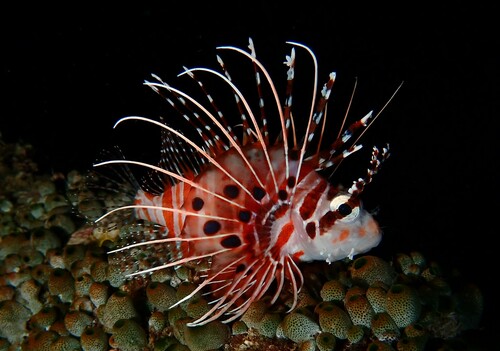
A long tentacle grows above each eye, and both coronal spines and many additional head spines are present.
Pectoral Fin Structure
The pectoral fin has 17 simple fin rays.
Dentition
Both the upper and lower jaws hold many very small teeth; these teeth are arranged in clusters on either side of the mouth, with an additional small patch at the front of the mouth’s roof.
Maximum Size
This species reaches a maximum total length of 20 cm (7.9 in).
Body Coloration and Barring
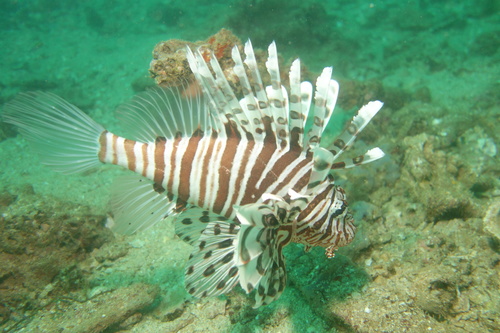
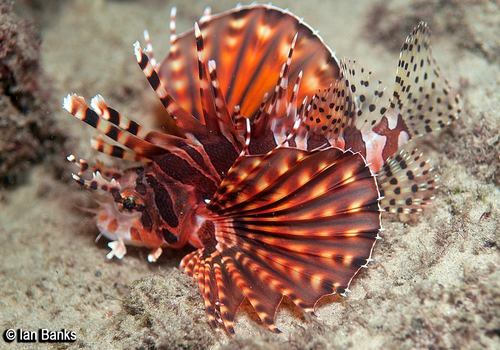
Its overall body color is reddish-brown, marked with numerous darker vertical bars that range from slender to wide; these bars are thin and angled on the caudal peduncle.
Fin Spotting
Dark spots are scattered across the anal, dorsal, and caudal fins.
Head Markings
The head is marked with 3 dark brown bars, one of which is a diagonal bar running through the eye that ends in a large spot on the lower operculum.
Ocular Tentacle and Pectoral Fin Markings
The long tentacles above each eye are banded, and larger adults have bluish-black blotches near the bases of the pectoral fins.
Global Distribution
Pterois antennata has a wide distribution across the Indo-West Pacific, ranging from the Gulf of Aden south to South Africa, east to French Polynesia, north to southern Japan, and south to Australia and the Kermadec Islands of New Zealand.
Australian Continental Range
In Australian waters, its range extends from Fremantle in Western Australia, north and east along tropical northern coasts, reaching at least as far south as Sydney in New South Wales.
Australian Outlying Range
It is also found at Ashmore Reef in the Timor Sea, on reefs in the Coral Sea, in the waters around Lord Howe Island, at the Cocos (Keeling) Islands, and at Christmas Island.
Habitat and Depth Range
It inhabits lagoon and seaward reefs at depths between 2 and 86 m (6 ft 7 in and 282 ft 2 in).
Subsistence and Commercial Fishery Relevance
This species is caught by some subsistence fisheries, but its small size and venomous spines make it of little interest to commercial fisheries.
Aquarium Trade Status
It is, however, common in the aquarium trade.