About Raphicerus melanotis (Thunberg, 1811)
Common Name & Coat Color
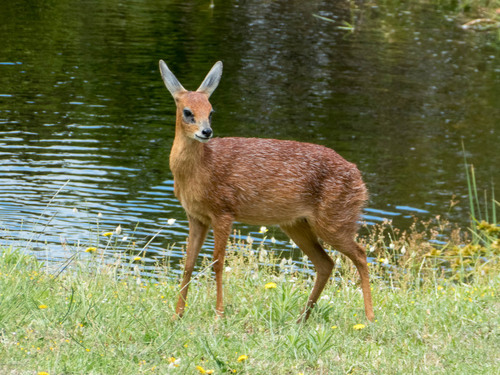
Raphicerus melanotis, commonly known as the Cape grysbok, has a rough, reddish sandy coat flecked with white. Its head, neck, and legs have less white flecking and appear somewhat yellowish, while the inside of the ears, eye-rings, area around the mouth, throat, and underside are white.
Facial Markings & Glands
It has a black "bridge" across its nose and a dark scent gland located in front of the eye.
Shoulder Height & Weight
The species stands 45–55 cm (21 inches) at the shoulder and weighs 8–12 kg (slightly more than 20 pounds).
Tail Characteristics
Its short tail measures 4 to 8 cm long and is almost invisible.
Horn Characteristics
Only males have short, sharp, straight, smooth horns, which reach roughly 8 cm in length.
Defensive Fur Behavior
The Cape grysbok can fluff the fur on its rear end to make itself look larger.
Native Habitat Range
Its native habitat is the Fynbos biome of the Cape Floristic Region, where it primarily lives in thick shrubland.
Anthropogenic Habitat Use
It can sometimes be found browsing in orchards and vineyards. In the Cape Peninsula, it occurs along urban edges near human activity.
Additional Habitats
It may also inhabit reed beds and riverbeds in the southern Karoo.