About Damaliscus pygargus (Pallas, 1767)
Scientific Classification and Build
The bontebok, scientifically named Damaliscus pygargus (Pallas, 1767), is a tall, medium-sized antelope.
Shoulder Height and Body Length
At the shoulder, bontebok typically stand 0.8 to 1 m (2.6 to 3.3 ft) high, with a total head-and-body length of 1.2 to 1.6 m (3.9 to 5.2 ft).
Tail Length and Body Mass
Their tails measure 30 to 60 cm (12 to 24 in), and body mass ranges from 50 to 68 kg (110 to 150 lb).
Sexual Size Dimorphism
Males are slightly larger and noticeably heavier than females.
Coat Coloration
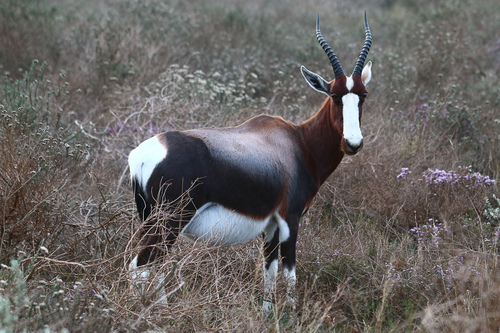
Bontebok have a chocolate brown coat, with a white underside and a white stripe running from the forehead to the tip of the nose.
Blesbok Facial Marking Difference
Most blesbok, the closely related type of this species, have an extra brown stripe across this white area near the eyes.
Rump Patch Variation
Bontebok also have a distinctive white patch surrounding the tail, which matches the meaning of the species' Latin name; in blesbok, this patch is light brown or tan instead.
Horn Structure
The horns of bontebok are lyre-shaped and have clear ringed texture.
Horn Growth and Length
Both sexes grow horns, which can reach up to half a metre in length.
Habitat and Diet
For habitat and behavior, blesbok live in the Highveld, where they feed on short grasses, while bontebok are restricted to coastal Fynbos and Renosterveld.
Activity Pattern
All of these antelope are diurnal, but they rest during the hottest part of the day.
Herd Composition
Their herds can consist of only males, only females, or a mix of both sexes.
Herd Size
Bontebok herds do not exceed 40 individuals, while blesbok herds may reach up to 70 animals.