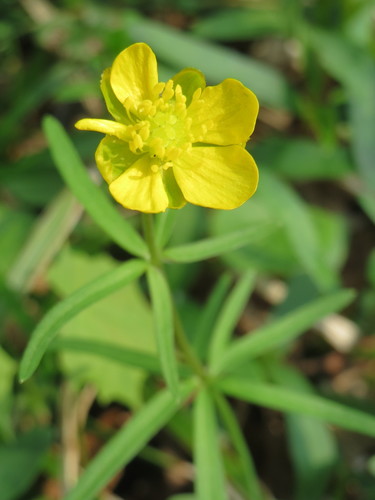
About Ranunculus auricomus L.
Ranunculus auricomus L. is a short, slightly hairy perennial herb that bears bright yellow flowers. It grows to a height of 30–100 centimetres, and can produce up to 10 basal leaves that range from non-dissected to palmately lobed. The upper stem leaves are deeply divided into 3 to 5 narrow segments, which gives the plant a filiform overall appearance. Leaf shape changes across the growing season, a trait called polyphylly, and only the most deeply dissected basal leaf holds value for taxonomic identification. This variation makes identifying R. auricomus taxa difficult when working from just a single individual from a given population.
Ranunculus auricomus is native to a large area spanning temperate to arctic regions of Europe and Asia, and also grows in parts of Greenland and Alaska. In Britain, it is generally a lowland species, but has been recorded growing at 1,090 metres (3,580 ft) on Aonach Beag. It is common across England and southern Scotland, but becomes increasingly uncommon moving north and west; for example, it is specifically named in the description of Coed Garnllwyd Nature Reserve in the Vale of Glamorgan.
This species is a perennial herb characteristic of deciduous woodland growing on base-rich soils, such as those underlain by chalk or limestone. It has also been recorded growing among scrub, along roadsides, in churchyards, and infrequently on open moorland in sheltered locations near boulders, as well as on sheltered mountain ledges. Flowering begins in March or April, and peaks at the end of May and start of June. The yellow buttercup flowers attract pollinating insects including Diptera and Coleoptera. The flowers are hermaphroditic, radially symmetrical, five-petaled, and have a double perianth. Not all five yellow petals are always fully developed. Diploid sexual progenitor species usually have a full set of petals, while polyploid apomictic hybrid taxa (also called nothotaxa) often have a reduced number of petals. Petal count also varies based on surrounding environmental conditions.
Pollination occurs via insect-mediated cross-pollination in self-incompatible species. In self-compatible apomictic species, pollination is often through self-pollination, and seeds develop from unfertilized ova. It has been hypothesized that asexual reproduction in plants reduces the efficiency of selection against deleterious mutations, because it eliminates genetic recombinational variation in populations. This deficiency is thought to lead to mutation accumulation, a gradual increase in mutational load called Muller’s ratchet, and ultimately the rapid extinction of these asexual lineages. However, apomictic, asexual R. auricomus appears to have overcome this limitation by retaining a small amount of sexual reproduction.