About Aquilegia sibirica Lam.
Growth Form
Like other Aquilegia species, the Siberian columbine (Aquilegia sibirica Lam.) has nectar spurs and is a hardy perennial plant.
Pollinators
Bees are the most common pollinators of A. sibirica, and it is also visited by other pollinators including butterflies; in introduced North American populations, it is also favored by hummingbirds.
Disease Resistance
This species is resistant to the fungal disease verticillium wilt.
Habitat Preferences
It prefers temperate environments, grows well in shaded areas, and tolerates a wide range of soils.
Leaf Characteristics
It has nearly glabrous bi- and triternate leaves, with leaflets between one and two inches across.
Stem Characteristics
Its stems are leafless, and many stems end in flower clusters.
Flower Coloration
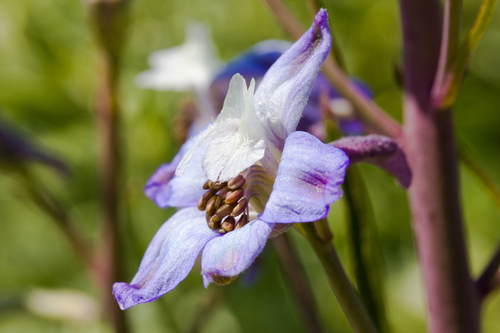
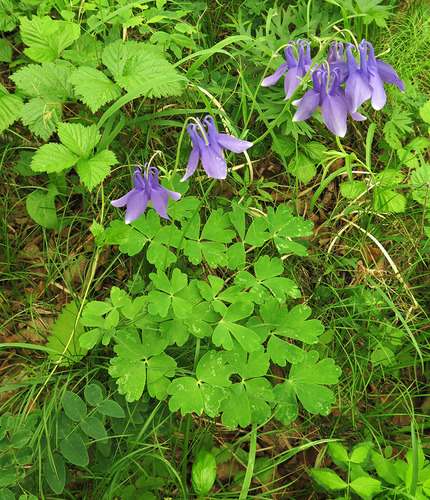
The flowers of Siberian columbine range from lilac-blue to white.
Reproductive Traits
They are bisexual, and produce indehiscent fruit (fruit that does not split open to release seeds) in the form of a follicle.
Mature Size
Mature plants reach between 1 foot (0.30 m) and 2 feet (0.61 m) in height.
Bloom Period
In northern latitudes, this species blooms from May to June.
Petal Development
Compared to other Aquilegia species, the petals of A. sibirica develop curvature relatively early when they are still short, between 1 centimetre (0.39 in) and 2 centimetres (0.79 in) long.
Petal Structure
The petals also fold longitudinally.
Nectar Spur Morphology
Nectar spurs of different Aquilegia species show high variance during development; A. sibirica's nectar spurs have greater curvature than those of A. formosa and A. chrysantha.
Genus Distribution
There are 70 to 80 total Aquilegia species distributed across the Circumboreal Region, spanning Eurasia and North America.
Native Range
Aquilegia sibirica is native to north-central Asia, where it occurs naturally in Siberia, northern Mongolia, Kazakhstan, and Xinjiang.
Biogeographic Context
When compared to the distribution of the closely related, similarly lowland species A. vulgaris, the current distribution of A. sibirica suggests a historical vegetation system may have once connected Central Europe and Siberia.
Relict Population Status
The Middle Siberian population of A. sibirica is classified as a quaternary relict, meaning it is a population that had a much wider range during an earlier geologic epoch.
Taiga Habitat Description
In 1921, researchers found that in open areas of the taiga in Siberia's Sayansky District, Siberian columbine and other vascular plants form dense, two-meter-tall vegetation that can obscure the view of people passing through the area.
Peatland Habitat
A. sibirica also grows in the herb layer of peatlands along the eastern coast of Lake Baikal.
Elevation Niche
Within its native range, it generally occupies lower elevation habitats, while the closely related Aquilegia glandulosa grows at higher elevations in the same general region.
Cultivation Status
Siberian columbine is cultivated in gardens around the world.
Introduction to North America
It was introduced to the United States by the United States Department of Agriculture in 1933, when A. P. Iljinski, chief botanist of the Leningrad Botanic Garden, presented its seeds to the U.S. on behalf of the Soviet Union.
Landscaping Use
Research from Finland indicates that A. sibirica is one of several Siberian and Far Eastern plants that may be useful for northern landscaping.
Hybrid Cultivar
In 1946, American botanist Philip A. Munz documented that A. sibirica had been hybridized with A. vulgaris to create the cultivated hybrid A. ×garnieriana.