About Ranitomeya variabilis (Zimmermann & Zimmermann, 1988)
Taxonomy and Naming
Ranitomeya variabilis, originally described by Zimmermann & Zimmermann in 1988 and formerly known as Dendrobates variabilis, is a species of small poison dart frog.
Its common name, Zimmerman's poison frog, honors German zoologist Elke Zimmermann, who described the species' morph and distinguished it from Dendrobates ventrimaculatus; the species was formerly considered synonymous with Ranitomeya ventrimaculata.
Geographic Distribution
This species is distributed across northern South America, specifically along the eastern slope of the Andes in the upper Rio Huallaga drainage basin in northern Peru, and also ranges into northern Peru, Ecuador, western Brazil, and southern Colombia in the western Amazonian-Orinocan Lowlands.
It has been found as far as 195 kilometers southeast into Brazil.
Habitat Climate
Its typical habitat has an average annual rainfall of around 2500 mm, with a dry season from June to September that is associated with changes in parental care and egg-laying behavior.
Habitat temperatures range from 16 to 32°C, and tend to be lower during the dry season.
Habitat Type
Adults are most often found in secondary to ancient forests, which provide suitable oviposition sites, and can also be found on higher arboreal perches.
Coloration
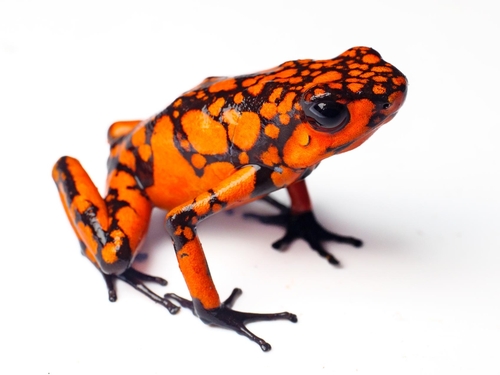
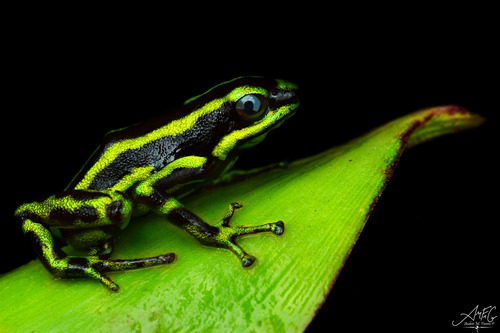
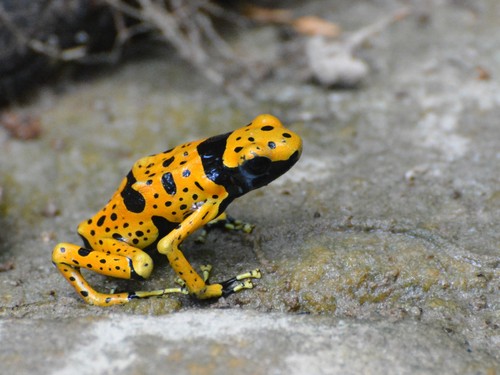
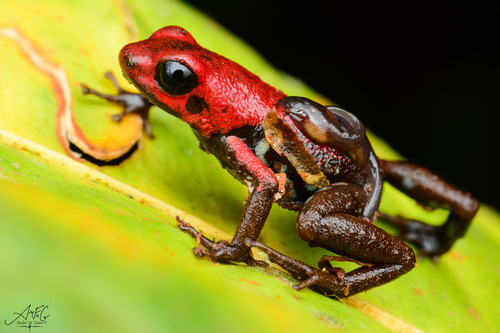
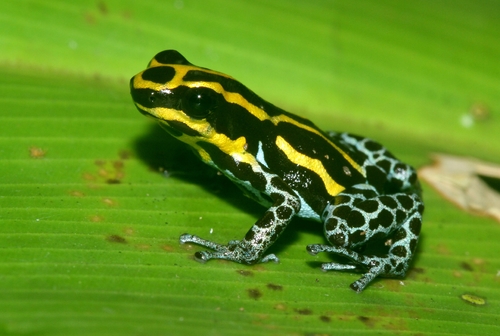
R. variabilis typically has a bright yellow body with deep blue limbs, and black spots or stripes on its ventral body; its color pattern varies across different geographic locations.
Mimicry Relationships
It forms different mimicry relationships with two other frog species.
Skin Defense
Like other members of its family, R. variabilis has toxic alkaloids in its skin that deter potential predators.
Tadpole Cannibalism
This species is cannibalistic even in the tadpole stage, so adult male parents will carry tadpoles on their backs to transport them to less crowded areas.
Tadpole Detection
Adult R. variabilis use chemical cues to detect the presence of tadpoles and assess whether the tadpoles are cannibalistic.
Home Range Size
Adult R. variabilis occupy home ranges that average around 31.3 square meters, the general area where they travel to find food.
Home Range Characteristics
Because this species has uniparental care provided by males, home ranges are less strongly tied to the availability of phytotelmata (small water pools in plants) and territoriality is minimal, compared to the biparentally caring species Ranitomeya imitator.
Males are often found far from their reproductive sites.
Due to the species' promiscuous mating system, home range overlap between individual breeding pairs is also lower.
Reproductive Timing
Reproduction takes place during the day, and peaks after rainfall.
Male Courtship Behavior
Males initiate advertisement calls when they encounter a female, and increase calling frequency as they approach the female.
Males typically call near a suitable phytotelma; after the female lays eggs, the male fertilizes them.
Egg Laying
Females usually lay 2 to 6 eggs in water.
Mating System
R. variabilis has a promiscuous mating system, meaning males and females mate randomly in a polygynous system, with little to no mate fidelity.
Calling Function
Males call from arboreal perches when females are present, and calling only occurs to attract mates.
Advertisement Call Properties
The species' call is a buzz with 106 to 297 pulses per second; each pulse lasts 0.14 to 0.44 seconds, with inter-pulse intervals of 0.6 to 2.0 seconds.
These short, high-frequency calls, which range from 4386 to 5624 Hz, are common among other frogs in the R. variabilis species group.
Male-Male Competition
When two males conflict over access to a female, they wrestle to establish dominance.
Fertilization Process
The dominant winner gains the opportunity to fertilize the eggs first, while the subordinate male gets a chance to fertilize the eggs after the dominant male, who continues to court the female even after the initial fertilization.
This fertilization process can repeat across multiple cycles.