About Hyloxalus infraguttatus (Boulenger, 1898)
Size
Males of Hyloxalus infraguttatus measure 17–21 mm (0.67–0.83 in) in snout–vent length, while females measure 20–23 mm (0.79–0.91 in).
Dorsal Coloration
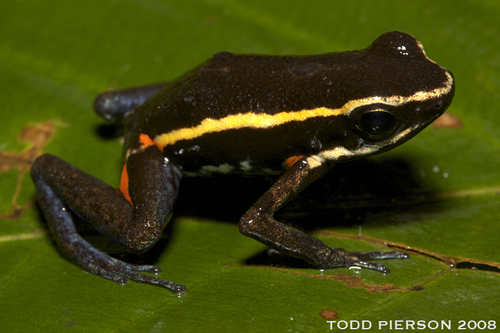
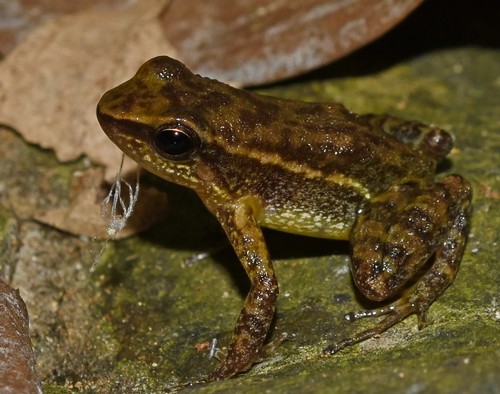
Dorsal body coloration ranges from greenish to pale and dark brown, marked with dark brown spots.
Lateral Stripe
Individuals have an oblique lateral stripe that reaches all the way to the eye.
Ventral & Reproductive Anatomy
White spots appear on the throat and abdomen, and the testicles of males are white.
Habitat Types
This species can be found in humid premontane forests, tropical thickets, thorny scrubs, and very dry tropical forests, in areas close to streams, water channels, road ditches, and pools.
Elevation Range
It occurs at elevations from 70 to 1,500 m (230 to 4,920 ft) above sea level.
Population Trend
Hyloxalus infraguttatus is locally common, but its population abundance has been decreasing over time.
Conservation Status
The International Union for Conservation of Nature classifies this frog as vulnerable to extinction.
Threats
Threats include habitat loss driven by agriculture, tree plantations, logging, and livestock grazing, plus landscape changes caused by introduced goats.
Reproduction Timing
Reproduction for Hyloxalus infraguttatus happens at the end of the rainy season.
Territoriality
Both adult males and adult females are territorial.
Mating Behavior
Males call to attract females.
Egg Laying
Females lay eggs on leaf litter and under rocks.
Parental Care
After eggs hatch, males carry the tadpoles on their back to water, and males only care for one clutch of eggs at a time.