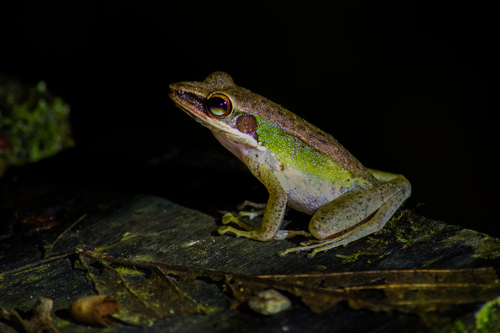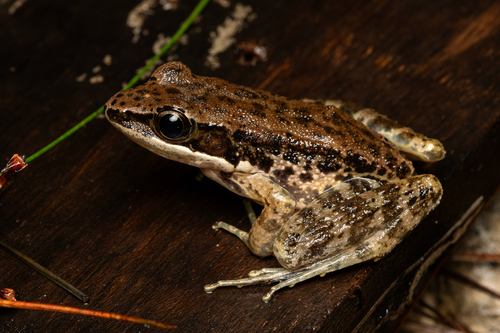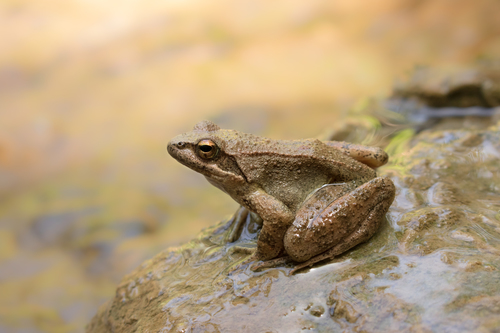
About Rana graeca Boulenger, 1891
Nomenclature and Classification
The Greek stream frog, also called simply the Greek frog, has the scientific name Rana graeca Boulenger, 1891. It is a species of frog in the family Ranidae, found in Albania, Bosnia and Herzegovina, Bulgaria, Greece, North Macedonia, Serbia, Montenegro and Turkey.
Natural Habitats
Its natural habitats are temperate forests, temperate grassland, rivers, intermittent rivers, freshwater springs, and pastureland.
Conservation Status
The International Union for Conservation of Nature does not consider this species threatened.
Reproductive Frequency and Timing
Greek stream frogs reproduce only once a year. Their reproductive period starts shortly after hibernation in February, and ends in April.
Male Calling Behavior
During reproduction, males produce calls that can come from either below or above the water surface, with calling happening mainly during the night. Males may also call during the day depending on water temperature.
Mating Site Preferences
The species prefers calling and mating sites that are safe and hidden, such as dark crevices in the stream bank under roots or stones.
Egg Laying and Mass Characteristics
After mating, egg masses are attached to the roof of a cavity. Each egg mass holds between 200 and 2000 individual eggs.
Egg Physical Traits
The eggs themselves are 2 to 3.5 millimetres in diameter, and are surrounded by a protective gelatinous envelope that measures 4 to 7 millimetres across.
Egg Guarding Behavior
Observations suggest that males may guard the eggs for some period of time.
Larval Development
Newly hatched larvae are around 9 millimetres in length, and grow to 45 millimetres over two to three months, though cooler water temperatures can slow their development.
Sexual Maturity
Young Greek stream frogs reach sexual maturity after their third hibernation.