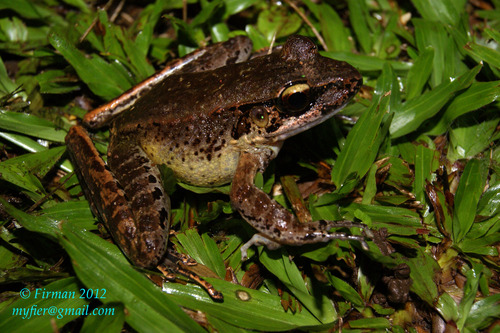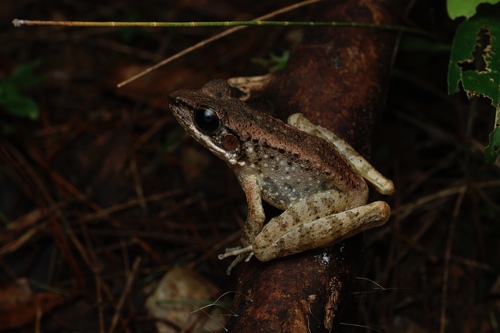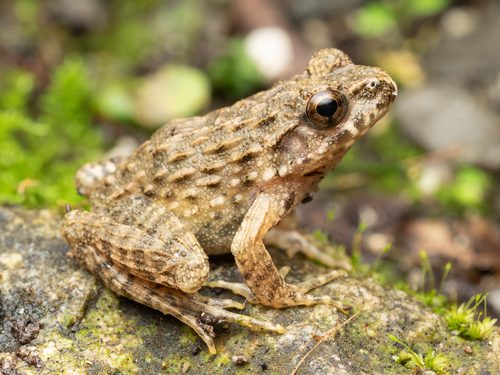
About Glandirana rugosa (Temminck & Schlegel, 1838)
Common Name & Classification
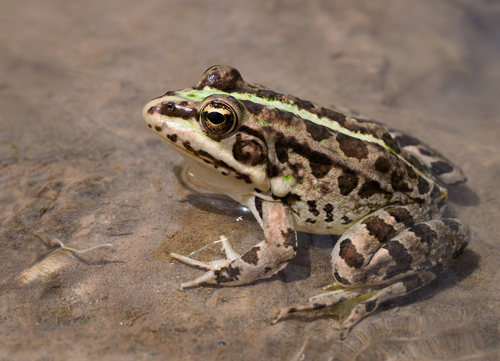
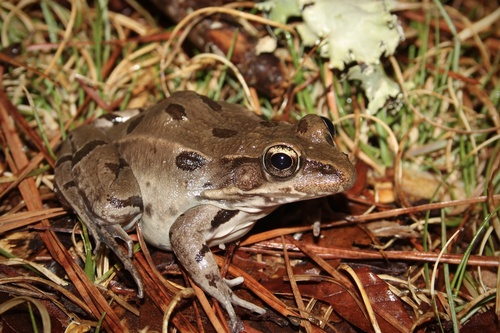
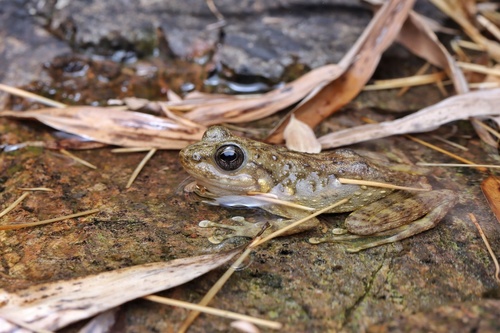
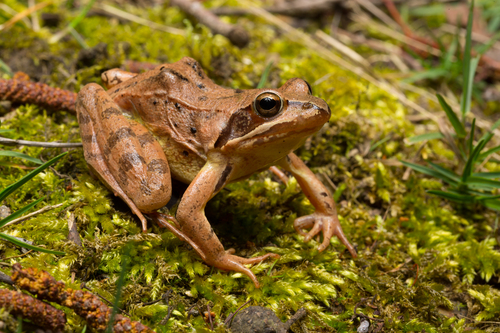
Glandirana rugosa, commonly known as the Japanese wrinkled frog, is a species of true frog. It is native to Japan, and was introduced to Hawaii in the late 19th century.
Taxonomic History
This species has sometimes been classified as a single species together with Glandirana emeljanovi, the Imienpo Station frog that occurs on the East Asian mainland.
Distinguishing Morphology
Both Glandirana rugosa and Glandirana emeljanovi can be distinguished from other species by their rough, uneven skin.
Habitat & Breeding Environment
Japanese wrinkled frogs live and breed in a range of different freshwater environments, including ponds, streams, and wetlands.
IUCN Threat Assessment
The International Union for Conservation of Nature (IUCN) has identified no major threats to this species.
Sex-Determination System Variation
Populations of Glandirana rugosa are especially notable for scientific research, because populations in different regions of Japan display both male heterogamety (the XX/XY sex-determination system) and female heterogamety (the ZZ/ZW sex-determination system).
Research Significance
This coexistence of two separate sex-determination systems within a single species makes the Japanese wrinkled frog an important model organism for research on the evolution and turnover of vertebrate sex chromosomes.
Sex Chromosome Evolution
Genetic and cytogenetic studies have found that the sex chromosomes of Glandirana rugosa, which originate from the same ancestral chromosome pair, have gone through multiple independent differentiation and "recycling" events via recombination and hybridization.
Population Genetic Structure
Phylogeographic analyses have uncovered deep genetic divisions between eastern and western Japanese populations of the species, which indicates that there may be unrecognized cryptic speciation within the currently defined Glandirana rugosa.
Conservation Status
The species is still common across most of Japan, especially in rice paddies and small freshwater systems, and is currently listed as Least Concern on the IUCN Red List.