About Pteropus dasymallus Temminck, 1825
Initial Species Comparison
The Ryukyu flying fox (Pteropus dasymallus Temminck, 1825) is slightly smaller than the Indian flying fox.
Size and Weight
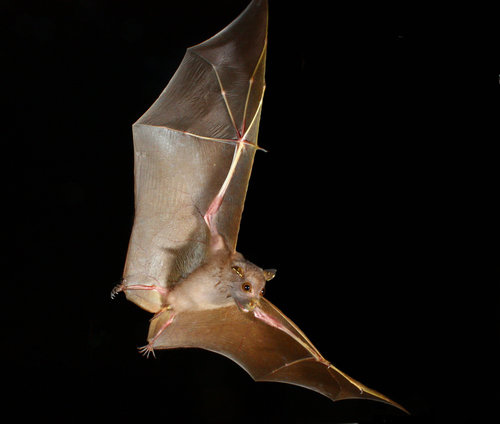
It has a wingspan of 1.24–1.41 m (4 ft 1 in – 4 ft 8 in), weighs 400–500 g (0.88–1.10 lb), and its forearm is approximately 140 mm (5.5 in) long.
Pelage Texture
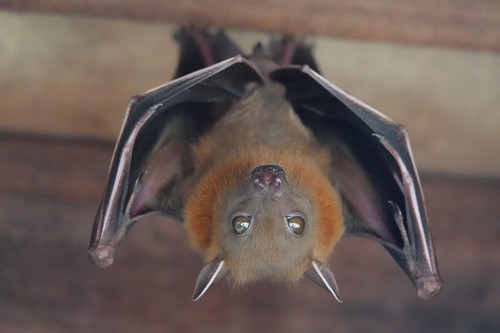
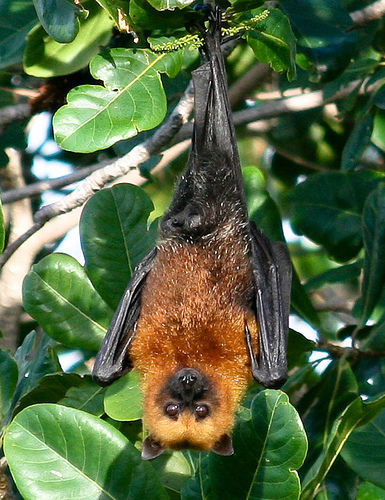
Its body is covered in long hairs that give it an almost woolly appearance.
Body Coloration
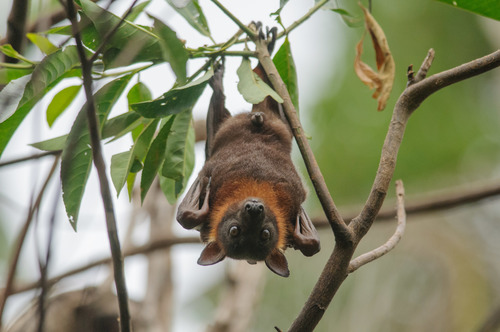
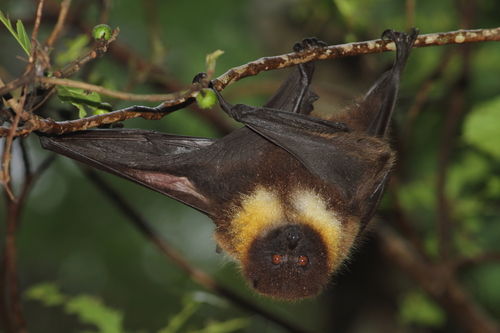
It is reddish brown with a yellowish white nape.
External Physical Features
Its small, pointed ears are hard to see beneath its thick fur, and its flight membranes are dark brown.
Overall Geographic Range
This species is native to Taiwan, Japan, and the Philippines.
Distribution in Japan
In Japan, it occurs on the Ōsumi Islands, Tokara Islands, Okinawa Islands, Miyako Islands, Yaeyama Islands, and Daitō Islands.
Distribution in the Philippines
In the Philippines, it is found in Batan, Dalupiri, and Fuga.
Roosting Habitat and Behavior
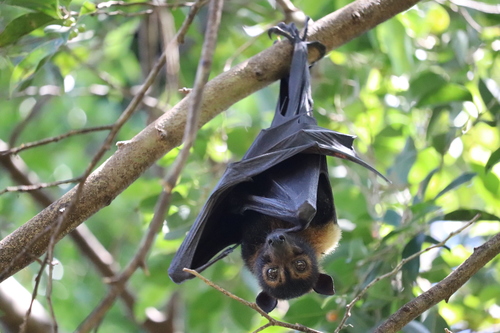
It lives in forests, where it roosts during the day in trees either singly or in small groups.
Feeding Guild
The Ryukyu flying fox is mostly frugivorous.
Diet Composition
It consumes fruits from at least 53 plant species, flowers from 20 plant species, leaves from 18 plant species, bark from one plant species, and has also been observed eating eight different insect species.
Key Food Source
The Chinese banyan tree is an important year-round food source for this species.
Pollination Role
It acts as an important pollinator for a subspecies of the evergreen tree Schima wallichii, and also pollinates the climbing vine species Mucuna macrocarpa.
Activity Pattern
It is a nocturnal species: it typically roosts alone in trees during the day, and forages at night.
Seed Dispersal Ability
It enhances seed dispersal, because seeds from digested fruits are deposited in guano up to 1,833 m (1.139 mi) away from parent trees.