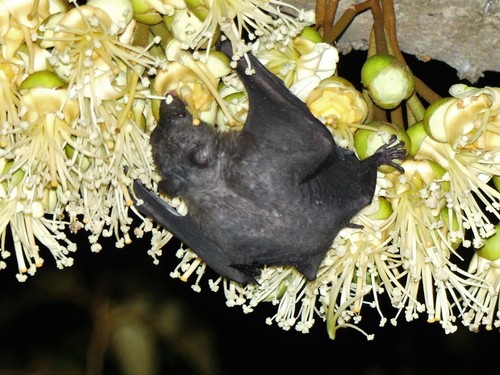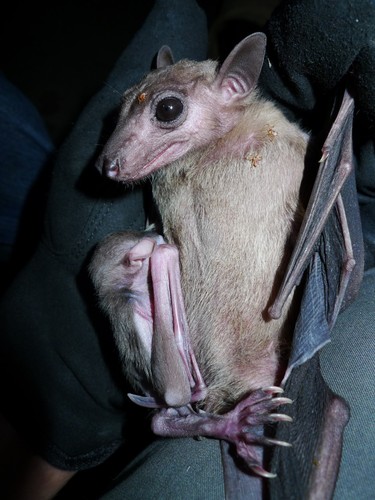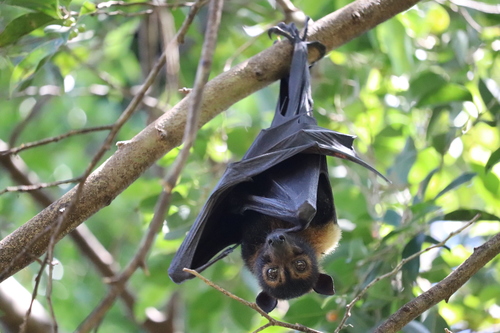
About Pteropus conspicillatus Gould, 1850
Size
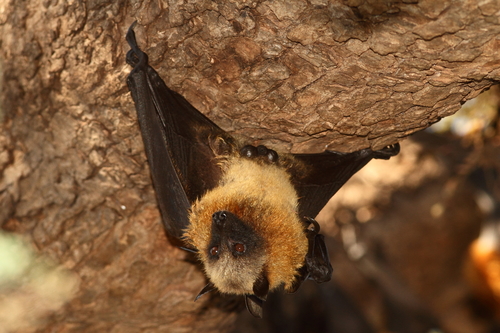
Pteropus conspicillatus Gould, 1850, commonly called the spectacled flying fox, has a head and body length of 22–25 cm, a forearm length of 16–18 cm, and weighs between 400 and 1000 g. As a large flying fox, it has pale yellow or straw-colored fur around its eyes.
Coloration
Its pale yellow mantle stretches across its back, neck, and shoulders, and some individuals also have pale yellow fur on the face and the top of the head.
Habitat
Spectacled flying foxes live in forests, and rainforests are their preferred habitat. They prefer to roost in the middle and upper canopy layers in full sun.
Colonies
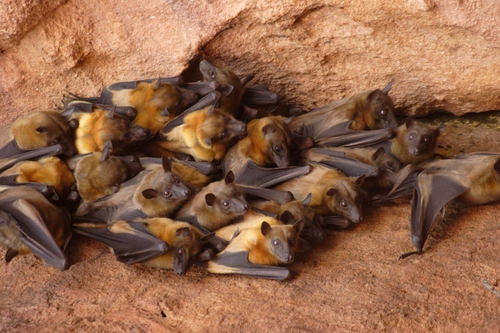
Their colonies can be found in rainforests, mangroves, paperbark forests, and eucalypt forests, and there is evidence that this species is increasingly occupying urban areas.
Breeding
Spectacled flying foxes produce one pup each year. Females are able to breed when they are one year old, while males most likely do not breed until they are three to four years old. This species is polygamous, similar to the closely related grey-headed flying fox Pteropus poliocephalus.
Population Ratio
The female-to-male ratio in populations can be as high as 2:1.
Mating Season
Conception takes place between April and May, and sexual activity occurs continuously from around January to June.
Birth
Females give birth to a single young each year between October and December.
Juveniles
Juveniles are nursed for more than five months; after weaning, they gather in nursery trees within the colony. Juveniles fly out with the colony at night to increasingly distant areas, where they are left 'parked' in nursery trees that are often several kilometers away from the main colony, and are brought back to the main colony each morning.