About Eonycteris spelaea (Dobson, 1871)
Appearance
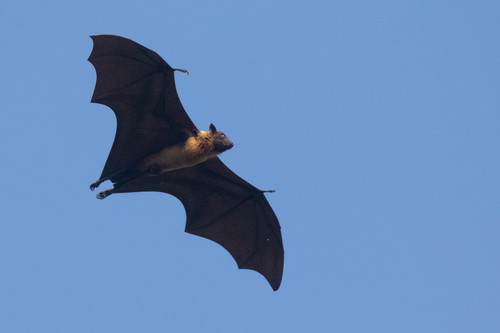
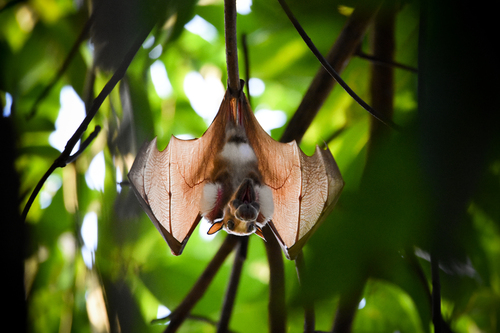
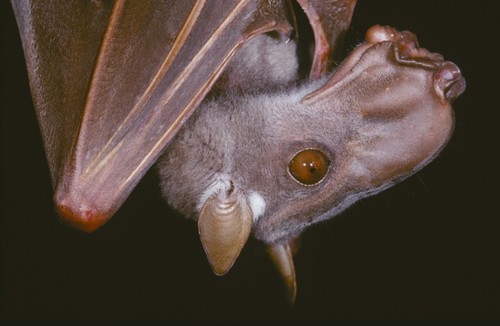
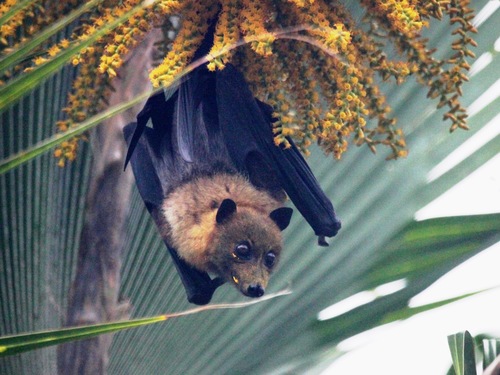
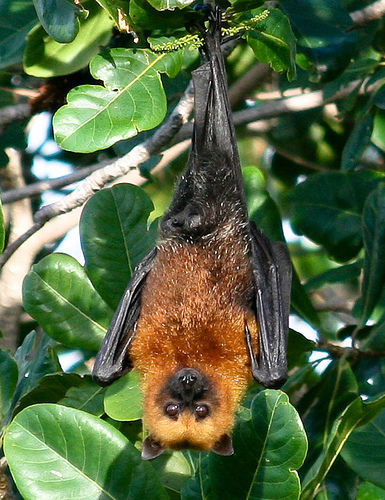
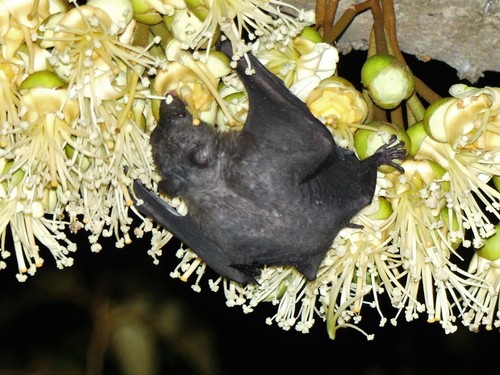
Eonycteris spelaea, commonly called the cave nectar bat, has upper fur ranging from grey-brown to dark brown to black. Its underparts are paler, and its neck is sometimes yellowish brown. It has an elongated muzzle specially adapted for drinking nectar, and also possesses an external tail.
Measurements
The species' head and body length measures 8.5–11 cm (3.3–4.3 in), its tail length measures approximately 1.5–1.8 cm (0.59–0.71 in), and its forearm length measures 6–7 cm (2.4–2.8 in).
Habitat and Roosting
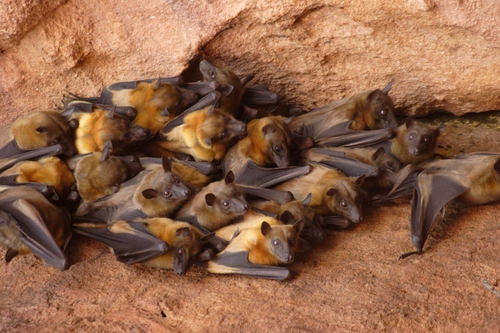
The cave nectar bat inhabits primary forests, disturbed areas, and agricultural regions. It roosts in caves in large groups, with some roosts hosting more than 50,000 individuals, and it will sometimes share roosts with other bat species. In some locations, this species has adapted well to leafy semi-urban habitats.
Conservation Status
While its large roosting size has led to it being classified as Least Concern by the IUCN, only limited data exists on its population size and population trends.
Feeding and Pollination
Each night, E. spelaea travels many kilometers to feed on nectar from flowering trees and shrubs. This makes the species a very important pollinator of fruit trees, including durians — specifically Durio zibethinus and Durio graveolens. It also feeds on and pollinates other commercially important crops, such as banana (Musa spp.) and jackfruit (Artocarpus heterophyllus).
Plant Use
In addition to these plants, the cave nectar bat acts as an important pollinator for up to 55 plant species overall, with at least thirteen plant taxa documented as food sources for the bat. Which plants the cave nectar bat feeds on and pollinates varies based on the proximity of the plants to the bat's roosting sites. For this reason, E. spelaea is considered an important pollinator species in disturbed areas that border urban areas and agricultural farms.
Distribution
This species is distributed across Bangladesh, Brunei, Cambodia, Indonesia (including Java, Kalimantan, Sumatra, Sulawesi and some smaller islands), Laos, Malaysia, Myanmar, Philippines, Singapore, Thailand, Vietnam, China, India, and Timor-Leste.
Recorded Sites
It has previously been recorded from Gomantong Caves, Sukau, Segama, and Madai in Sabah; Niah, Sungai Tinjar, and Kuching in Sarawak; and Sungai Tengah and Kutai in Kalimantan.