About Hypsignathus monstrosus H.Allen, 1861
Common Name and Range
Hypsignathus monstrosus, commonly called the hammer-headed bat, is the largest bat found in mainland Africa.
Wingspan and Forearm Length
Males can have wingspans up to 90.1 cm (2.96 ft), and every individual has a forearm length longer than 112 mm (4.4 in).
Sexual Dimorphism in Weight
This species has the most pronounced sexual dimorphism of any bat species in the world; males can be up to twice as heavy as females, with an average male weight of 420 g (15 oz) compared to an average female weight of 234 g (8.3 oz).
Male Vocalization Adaptations
Other sex differences are tied to the species' social system, where males produce loud, honking vocalizations. As a result, males have greatly enlarged larynges that are about three times the size of females' larynges.
Larynx Structure
The male larynx extends through most of the thoracic cavity and measures half the length of the spine, so large that it displaces other organs including the heart, lungs, and gastrointestinal tract.
Pharyngeal Air Sacs
Males also have resonating pharyngeal air sacs connected to a large sinus in their humped snout, which increase the volume of their sound production. These numerous adaptations related to vocalization led scientists Herbert Lang and James Chapin to remark, "In no other mammal is everything so entirely subordinated to the organs of voice".
Facial Sexual Dimorphism
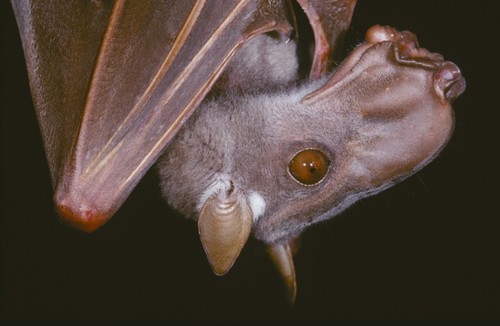
Overall, males have boxy heads with enormous lips, while females have narrower snouts and more foxlike faces.
Fur Coloration
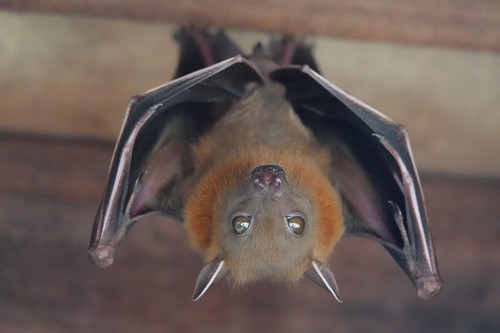
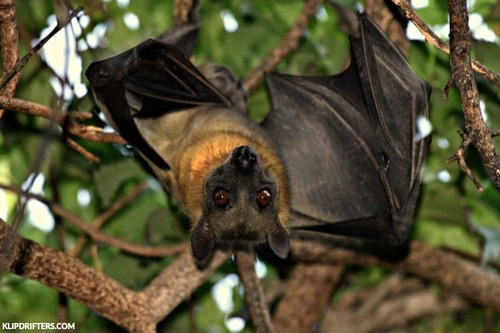
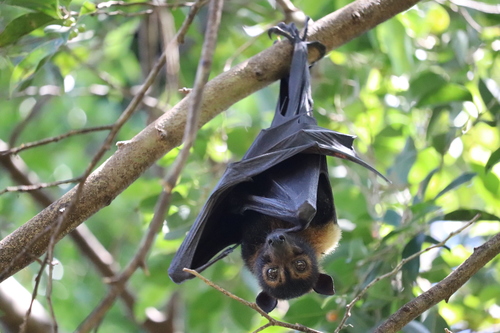
Both sexes have dark brown fur with a paler mantle covering the sides and back of the neck. There are patches of white fur at the base of the ears, though these patches are sometimes indistinct.
Fur Texture
The fur is long and smooth, with a somewhat woolly texture on the mantle.
Head Features
The species has triangular, blackish-brown ears and very large eyes.
Dental Formula
Its standard dental formula is 2.1.2.1 / 2.1.3.2, giving a total of 28 teeth; very occasionally, individuals have an additional upper premolar on each side of the mouth for a total of 30 teeth.
Skull Structure
The skull is larger and more robust than that of any other megabat in Africa, with a pronounced, massive snout.
Tongue Structure
The tongue is large and powerful, with an expanded, tridentate tip, and has backwards-facing papillae used to extract juice from fruits.
Wing Aerodynamics
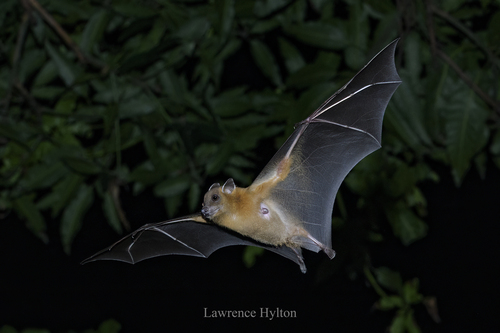
The wings have a low aspect ratio, meaning the wingspan is smaller relative to the wing area, and exceptionally high wing loading, meaning body weight is large relative to wing area. The wings are blackish brown.
Wing and Limb Features
The thumb is approximately 128–137 mm (5.0–5.4 in) long, and the wings attach to the hindlimbs at the second toe. The hammer-headed bat has no tail.
Sex Determination System
Unlike the typical mammalian karyotype (where females have two X chromosomes and males have one X and one Y chromosome), male hammer-headed bats have a single X chromosome and no Y chromosome, a system called X0 sex-determination.
Karyotype Details
Females have 36 total chromosomes (34 autosomes and two sex chromosomes), while males have 35 total chromosomes (34 autosomes and one sex chromosome). This karyotype is also seen in a few other bat genera, including Epomophorus and Epomops.
Elevation Range
The hammer-headed bat is a lowland species that always occurs below 1,800 m (5,900 ft) above sea level.
Habitat Preferences
Most records of the species are from rainforest habitats, including lowland rainforest, swamp forest, riverine forests, and forest-grassland mosaics. Though it has been documented in savanna habitats, these records are rare, and it is speculated that these individuals are vagrants.
Geographic Distribution
It has a wide range across West and Central Africa, occurring in Angola, Benin, Burkina Faso, Cameroon, Central African Republic, Republic of the Congo, Democratic Republic of the Congo, Ivory Coast, Equatorial Guinea, Ethiopia, Gabon, Ghana, Guinea, Guinea-Bissau, Kenya, Liberia, Nigeria, Sierra Leone, Sudan, Togo, and Uganda.
Reproduction Overview
Little is known about reproduction in hammer-headed bats. In some populations, breeding is thought to happen semi-annually during dry seasons.
Breeding Season Timing
The timing of the dry season varies by location, but generally the first breeding season runs from June to August and the second runs from December to February.
Female Reproductive Traits
Females can become pregnant up to twice per year, with a gestation period of five or six months, and typically give birth to one offspring at a time, though twins have been reported. Newborns weigh approximately 40 g (1.4 oz) at birth.
Sexual Maturity
Females reach sexual maturity faster than males, and can reproduce at six months old, reaching adult size by nine months old. In contrast, males do not reach sexual maturity until eighteen months old.
Juvenile Size
Males and females are similar in size during their first year of life.
Lek Mating System
This species is often cited as an example of classical lek mating, and is perhaps the only bat species to use this mating system.
Lek Mating Criteria
Classical lek mating is defined by four criteria: males gather in a specific region called a lek, where they establish display territories; display territories provide no beneficial resources to females beyond access to males; mate choice is entirely up to females, and all copulation occurs at the lek; and males do not assist females in caring for offspring.
Lek Formation
During the 1–3 month mating season, males form these leks along streams or riverbeds. Leks contain 20–135 males in an area about 40 m (130 ft) wide and 400–1,600 m (1,300–5,200 ft) long.
Male Display Behavior
Each male claims a display territory around 10 m (33 ft) in diameter, where he honks repeatedly and flaps his wings while hanging from a branch. Males typically produce 60–120 honks per minute.
Display Timing
They display for around four hours before foraging, with peaks in lekking activity in the early evening and before dawn. The majority of copulation occurs during the early evening peak.
Female Mate Selection
Females fly through the lek and select a male by landing on a branch next to him. The chosen male emits a "staccato buzz" call, followed immediately by copulation that lasts 30–60 seconds.
Post-Copulation Behavior
After copulation, the female immediately departs, and the male resumes displaying.
Mating Success Rates
Males located at the center of the lek have the highest mating success, and account for the majority of matings: the top 6% of males get 79% of all matings.
Dawn Lek Activity
During the before-dawn activity peak, copulation is less frequent, and males spend time competing with each other for the best display territories. As the mating season progresses, the importance of the before-dawn peak lessens.
Alternative Mating System
However, some West African populations of hammer-headed bats do not use leks, and instead use a harem mating system.
Pest Status
As a frugivorous (fruit-eating) species, the hammer-headed bat is sometimes considered a pest of fruit crops. Its ability to produce extremely loud vocalizations leads some to consider it one of Africa's most significant nocturnal pests.
Human Use
Humans hunt this large bat for food, and it is eaten in Nigeria, as well as seasonally in the Democratic Republic of the Congo.