About Pteroidichthys amboinensis Bleeker, 1856
Body Shape
Pteroidichthys amboinensis has the elongate, compressed body that is typical of the genus Pteroidichthys.
Fin Structure
This species has 12 flexible spines and 9 soft rays in its dorsal fin, and 2 spines and 6 soft rays in its anal fin.
Snout Characteristics
It has a relatively short snout, which averages around 14% of its standard length.
Maxilla Position
The rear margin of the maxilla extends past a vertical line running through the centre of the pupil.
Cranial Spines and Tentacles
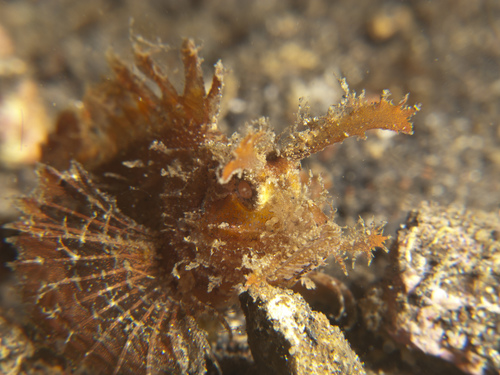
The species has supraorbital tentacles, and its posterior lacrimal spines are well developed, longer than the diameter of the orbit.
Body and Fin Tentacles
There are many tentacles across the body and fins.
Lacrimal and Suborbital Spines
The lateral lacrimal and suborbital spines are indistinct; they are normally very small spines, and frequently take the form of blunt, bony protuberances.
Dorsal Fin Marking
There is no distinct black blotch on the soft-rayed portion of the dorsal fin.
Colouration
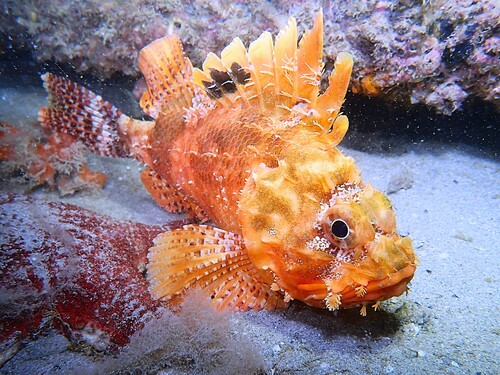
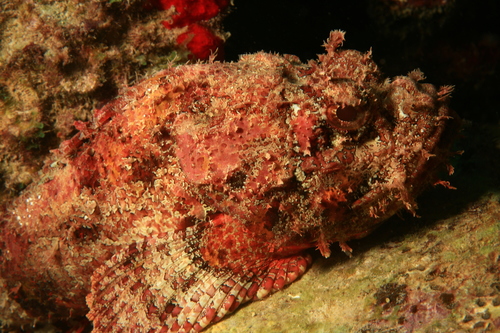
These fish sometimes show a mottled blackish and reddish colouration, but can make wide changes to their overall colour and pattern.
Size
This species reaches a maximum known total length of 12 cm (4.7 in).
Distribution
Pteroidichthys amboinensis occurs in the Red Sea, through the Indian Ocean and into the western Pacific Ocean, reaching as far east as Fiji, north to southern Japan, and south to Australia.
Habitat and Depth
It is a demersal fish found at depths between 7 and 43 m (23 and 141 ft), living over soft substrates and among algae.