About Scorpaena plumieri Bloch, 1789
Scientific Identity
This species, Scorpaena plumieri Bloch, 1789, has a robust body.
Dorsal and Pectoral Fin Ray Counts
Its dorsal fin has 12 spines and nine soft rays, and its pectoral fin has 18–21 fin rays.
Dorsal Spine Venom Glands
Venom glands are associated with the dorsal fin spines to defend against predators.
Suborbital Crest Structure
It has a suborbital crest formed by infraorbital bones two and three, each bearing one or two spines.
Facial Skin Appendages
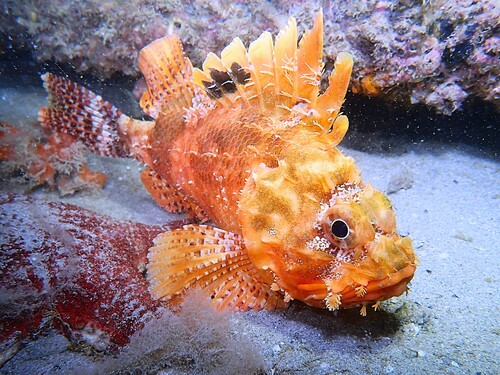
Under the eyes, it has fleshy plumes called "cirrae", with skin flaps around the chin and head.
Fin Shape Characteristics
It has wide, fan-shaped pectoral fins, a continuous, notched dorsal fin, and a truncated caudal fin.
Head and Mouth Structure
Its maxilla extends beyond the eyes, its mouth is terminal, and it has a well-developed occipital pit.
Species Size Context
It is the largest scorpionfish in the Atlantic and Caribbean oceans.
Recorded Size and Weight
The largest recorded individual measured 45 centimetres (18 in) long; on average, this species grows to between 18 and 36 centimetres (7.1 to 14.2 in), and can reach a weight of 1.55 kilograms (3.4 lb).
Body Coloration
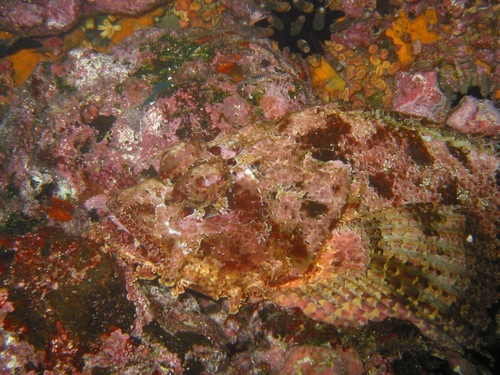
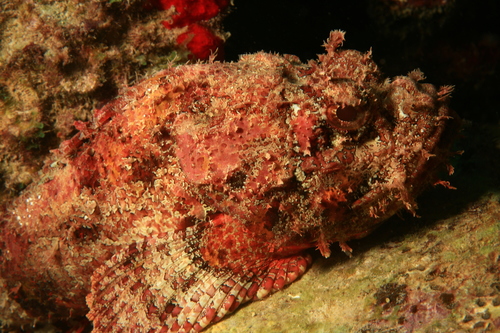
Its body colour ranges from brown to black over a light background, and the area directly before the caudal fin is abruptly paler.
Head and Ventral Coloration
The head has dark spots, and the ventral surface is orange or red.
General Fin Markings
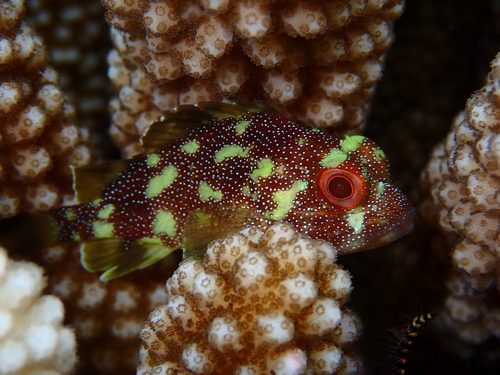
Its fins have dark bands and spots on a light background, most often with green spots.
Caudal Fin Markings
The tail fin has dark bars across its middle and near its end.
Pectoral Fin Interior Markings
The inside of the pectoral fins is marked with white.
Threat Display Behavior
When threatened, it extends its pectoral fins to display their bright colour.
Western Atlantic Distribution
This species inhabits the western Atlantic Ocean, ranging from Bermuda to Massachusetts, and from the northern Gulf of Mexico to southern Brazil.
Eastern Atlantic Distribution
It is also found in the Eastern Atlantic Ocean around Ascension Island and St. Helena.
Habitat and Depth Range
It lives in shallow coral reefs and rocky areas, and is moderately common at depths between 5 and 55 metres (16–180 ft).
Feeding Behavior
It stays motionless on the lower substrate, waiting to ambush prey.
Reproductive Traits
Its reproduction is not well understood, but it is confirmed to be oviparous, with females producing transparent or greenish eggs.