About Psittacula cyanocephala (Linnaeus, 1766)
Scientific Naming and Base Color
The plum-headed parakeet, scientifically named Psittacula cyanocephala (Linnaeus, 1766), is a predominantly green parrot.
Body Size Measurements
It measures 33 to 37 cm (13 to 15 in) in total length, weighs 55 to 85 g (1.9 to 3.0 oz), and has a tail reaching up to 22 cm (8.7 in) long.
Sexual and Age Plumage Dimorphism
There are distinct plumage differences between adult males, adult females, and immature birds.
Male Head Plumage
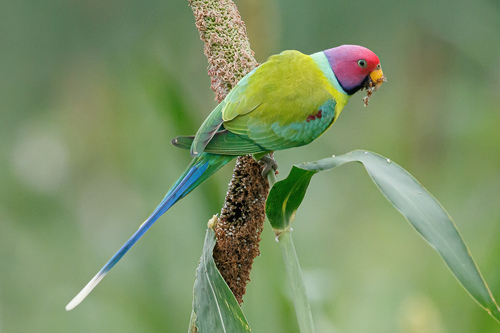
Males have a red head that fades to purple-blue on the back of the crown, nape, and cheeks.
Male Body and Beak Features
They have a narrow black neck collar with verdigris below it on the nape, a black chin stripe extending from the lower mandible, a red shoulder patch, bluish-green rump and tail with the tail tipped white. Males also have an orangish-yellow upper mandible and a dark lower mandible.
Female Plumage and Beak Features
Females have a dull blueish-gray head, no black and verdigris neck collar (this is replaced by yellow), a corn-yellow upper mandible, and lack both the black chin stripe and red shoulder patch.
Immature Bird Plumage
Immature birds have a green head, yellowish mandibles on both upper and lower, and do not develop their dark adult head until one year old.
Male Head Color Formation
The delicate bluish-red appearance of the male's head, which resembles the bloom on a peach, is created by a combination of blue from optical effects produced by feather rami and red pigment in the feather barbules.
Historical Subspecies Classification
Some authors previously divided the species into two subspecies: the nominate subspecies from peninsular India, with its type locality restricted to Gingee, and the subspecies bengalensis from the Himalayan foothills, based on the observation that males from the foothills have heads that are more red and less blue.
Current Taxonomic Status
However, newer taxonomic works treat this species as monotypic, with no accepted subspecies.
Differentiation from Blossom-headed Parakeet
This species can be distinguished from the closely related blossom-headed parakeet (P. roseata) by its head color and white-tipped tail; in contrast, P. roseata has a maroon shoulder patch and a shorter tail tipped yellow.
Intermediate Parakeet Hybrid Origin
The supposed separate species intermediate parakeet (Psittacula intermedia) is currently thought to be a hybrid between the plum-headed parakeet and the slaty-headed parakeet (P. himalayana).
Habitat Preferences
The plum-headed parakeet inhabits forests and open woodlands, and it can even live in city gardens.
Native Range
Its native range extends from the Himalayan foothills south to Sri Lanka, and it is not found in the dry regions of western India.
Introduced Populations
It is sometimes kept as a pet, and escaped individuals have been recorded in New York, Florida, and parts of the Middle East.
Vocalizations
This is a gregarious, noisy species that produces a range of raucous calls; its typical flight and contact call is a repeated tuink.
Flight Characteristics
Its flight is swift, and the bird often twists and turns rapidly.
Local Movements Drivers
It makes small local movements that are driven mainly by the availability of its preferred food: fruits and blossoms.
Diet Composition
Its diet includes grains, fruits, and the fleshy petals of flowers such as Salmalia and Butea, and it sometimes raids agricultural fields and orchards.
Breeding Season Timing
In India, the main breeding season runs from December to April, while in Sri Lanka it runs from July to August.
Courtship Behavior
Courtship behavior includes bill rubbing and courtship feeding.
Nesting and Egg Laying
The breeding pair chisels out a nest hole in a tree trunk, and the female lays 4 to 6 white eggs.
Parental Care
Only the female is responsible for incubating eggs and feeding hatchlings.
Roosting Behavior
Plum-headed parakeets roost communally.
Captive Mimicry Ability
In captivity, this species can learn to mimic beeps, short whistling tunes, and can mimic speech very well.
Recorded Parasites
Two parasite species have been recorded from this species: Neoaulobia psittaculae, a quill mite, and Haemoproteus handai, a blood parasite described from blood samples taken from the plum-headed parakeet.