About Amazona barbadensis (Gmelin, 1788)
Scientific Classification and Basic Appearance
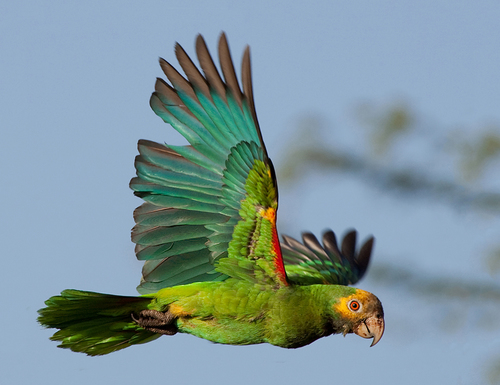
The yellow-shouldered amazon, with the scientific name Amazona barbadensis (Gmelin, 1788), is mainly green and approximately 33 cm (around 13 inches) long. It has a whitish forehead and lores, with yellow coloring on the crown, ocular region, and often the ear coverts and chin.
Head Markings
Its bare eye-ring is white.
Wing and Body Markings
Yellow markings appear on the thighs and the bend of the wing, commonly called the shoulder, though both can be hard to see. The throat, cheeks, and belly often have a bluish tinge.
Feather Structure
Like most members of the genus Amazona, it has broad dark blue tips on the remiges and a red wing-speculum.
Similar Species Distinction (Plumage)
This species can be distinguished from the very similar orange-winged amazon by the fact that orange-winged amazons lack yellow shoulders and blue coloration around the eyes.
Similar Species Distinction (Vocalization)
Another way to tell it apart from other Amazona species is its somewhat higher pitched vocalizations.
Native Distribution
A. barbadensis is endemic to northern Venezuela, Bonaire, and other nearby islands.
Bonaire Population Size
Bonaire may hold fewer than 400 individual birds.
Margarita Island Population Status
On the Venezuelan island of Margarita, it has been extirpated from the heavily commercialized eastern side, a popular tourist destination, and survives only on the Macanao Peninsula.
Aruba Historical Extinction
It was also originally native to Aruba, but went locally extinct there by 1947.
Aruba Reintroduction Status
In January 2024, a population of over two dozen of these birds was reintroduced to Aruba, and this new population is doing well.
Introduced Populations
An introduced population of A. barbadensis lives on Curaçao.
Habitat Preferences
Unlike other members of the genus Amazona, it is typically found in arid habitats, such as desert scrub and dry forests.
Diet Composition
It feeds on fruits, seeds, and flowers, and frequently eats parts of cactus plants.
Water Adaptation
This parrot can survive with very little additional water, getting most of its required moisture from its diet.
La Blanquilla Habitat Context
This is particularly noticeable on La Blanquilla, a small island that has no natural bodies of water.
Moisture Source in Arid Environments
The cacti it often eats are filled with liquid in both their stems and fruits, which keeps the parrots alive in their arid environment.