About Pseudocheilinus octotaenia Jenkins, 1901
Common Name & Base Body Color
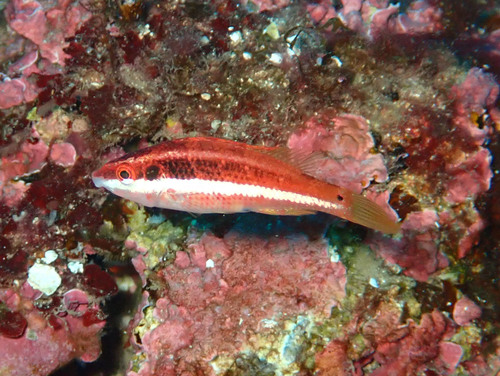
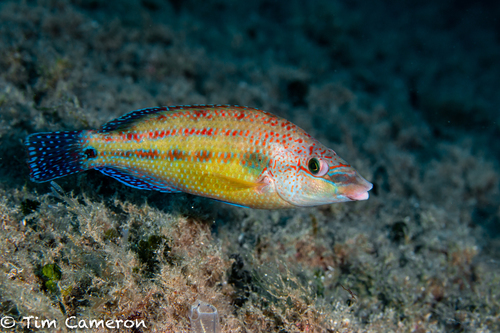
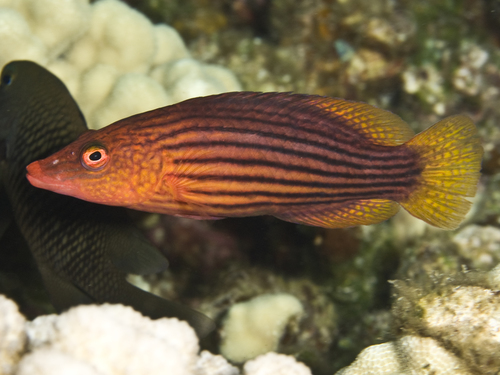
Pseudocheilinus octotaenia, commonly called the eight-lined wrasse, has a base body color ranging from reddish to yellowish.
Flank Stripe Pattern
It has approximately eight thin, purplish horizontal stripes running along its flanks, with the top three stripes extending onto its head.
Head & Body Markings
Small yellow spots appear on its cheek and gill cover, and some individuals have large yellow markings that may be blotches or dashes across their bodies.
Maximum Length
This species reaches a maximum standard length of 14 cm (5.5 in).
Taxonomic History
This species was first formally described by American physiologist and histologist Oliver Peebles Jenkins (1850–1935) in 1901, with its type locality recorded as Honolulu, Oahu, Hawaii.
General Distribution Range
The eight-lined wrasse has an Indo-West Pacific distribution.
Specific Distribution Localities
In the western Indian Ocean, it occurs from the Comoros and the Seychelles; in the Pacific Ocean, it ranges east to Hawaii and Ducie Island, north to Japan’s Yaeyama Islands, and south to New Caledonia.
Reef Habitat Type
This is a benthopelagic species that inhabits rubble or live coral areas on seaward reefs.
Habitat Features & Depth Range
It prefers regions with caves and crevices that support abundant invertebrate growth, and has been recorded at depths down to at least 40 metres (130 ft).
Diet Composition
It is a carnivorous fish that feeds mostly on benthic crustaceans, and also preys on small molluscs, sea urchins, fish eggs, and crab larvae.
Activity Pattern
The eight-lined wrasse is a solitary, diurnal species.
Nocturnal Shelter Behavior
It shelters in cavities, and creates a mucus cocoon to sleep in at night.
Mucus Cocoon Function
It is thought that this cocoon protects the fish from nocturnal predators by masking the sleeping individual’s scent.