About Pictilabrus laticlavius (Richardson, 1840)
Body and Head Structure
Pictilabrus laticlavius has a moderately deep, laterally compressed body, where body height measures 26 to 32% of the fish's standard length. It has a quite large head, relatively large eyes, and a small mouth, where the upper jaw does not reach the eye.
Jaw Dentition
The jaws hold small, canine-like teeth. The front pair of teeth in the lower jaw and the front two pairs in the upper jaw are enlarged and recurved, and there is an enlarged canine on each side at the posterior end of the upper jaw.
Scale Characteristics
This species has moderately large, firmly attached cycloid scales that cover the body. The head is mostly scaleless, with the exception of one to three rows of scales on the cheek and eight to ten large scales on the gill cover.
Lateral Line and Dorsal Fin
The lateral line curves abruptly downwards below the rearmost spines of the dorsal fin. The dorsal fin is continuous, has an elongated base, and maintains a uniform height along its entire length.
Anal and Caudal Fins
The anal fin matches the shape of the posterior portion of the dorsal fin, and sits opposite this portion of the dorsal fin. The caudal fin is truncate, while the pectoral fins are short and rounded.
Pelvic Fin Features
The pelvic fins are also short, their origins are located underneath the base of the pectoral fins, and they do not reach the area of the anus.
Male Coloration
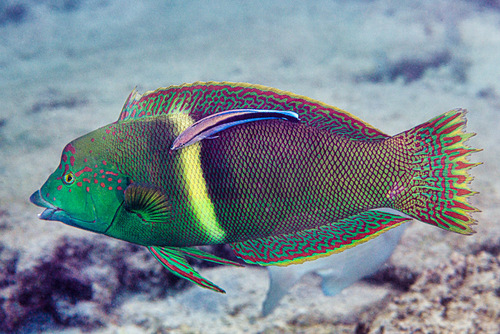
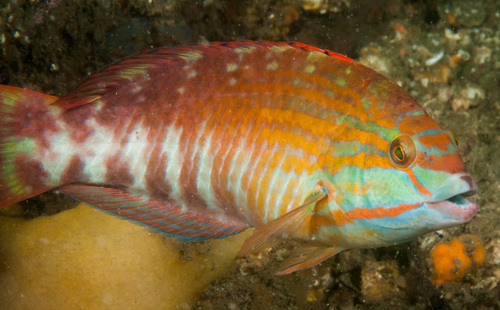
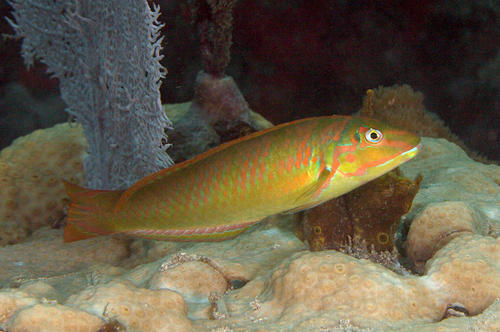
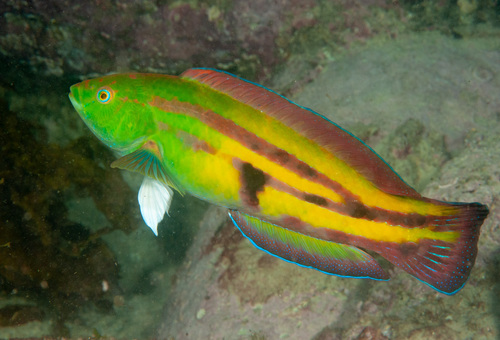
Males of this species are primarily green, with maroon or purplish stripes running along their flanks.
Female and Juvenile Coloration
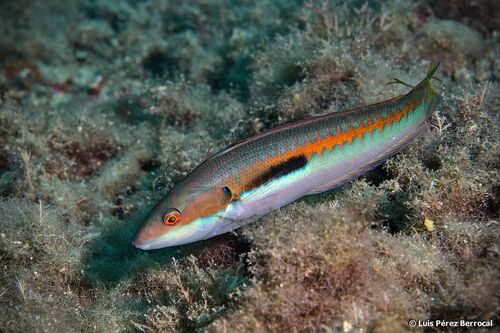
Females and juveniles range in colour from reddish to greenish-brown, and have a row of black spots above their lateral line, 4 to 5 blackish bars on their lower flanks, and a black spot on the posterior portion of the dorsal fin.
Species Distribution
Pictilabrus laticlavius is endemic to temperate waters off southern Australia, ranging from Byron Bay, New South Wales to the Houtman Abrolhos, Western Australia, and its distribution also extends to Tasmania.