About Halichoeres garnoti (Valenciennes, 1839)
Scientific Naming and Size
The yellowhead wrasse, scientifically known as Halichoeres garnoti (Valenciennes, 1839), is a small fish that grows to a maximum length of 19 centimeters.
Life Stage Trait Variability
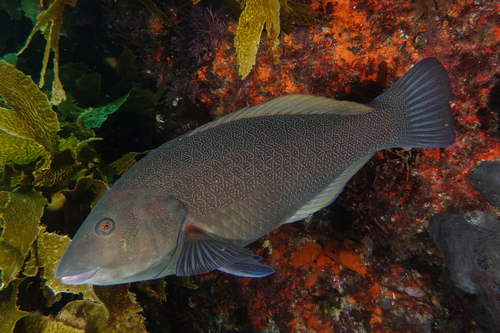
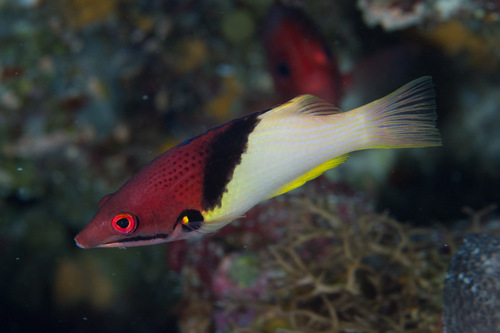
Over its lifetime, this species changes both its sex and appearance, and the coloration of each life stage is quite variable.
Body Shape
It has a thin, relatively elongated body with a terminal mouth.
Juvenile Coloration
As a juvenile, it is mostly yellow, with a bright blue lateral stripe along its side.
Initial Female Phase Coloration
In its initial female phase, it has a dark back that sometimes shows bluish tints, paired with a yellow underside.
Female Phase Head Markings
Two short, wavy dark lines extend outward from the back edge of each eye, and there are dark spots on the front of its head.
Adult Male Body Coloration
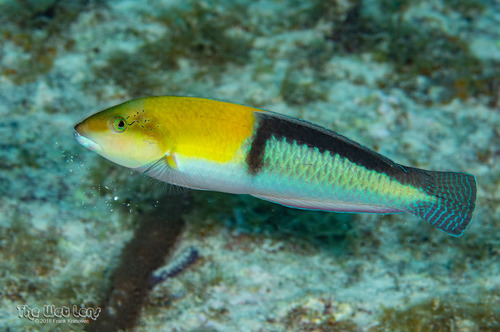
When it matures into an adult male, the head and front portion of the body are yellow, while the rear half of the body is silvery grey.
Male Dorsal Fin Markings
A vertical blackish-blue bar and a broad blackish-blue stripe run along the margin of the dorsal fin.
Male Longitudinal Body Lines
Starting from this dark blue stripe, three gradient-colored longitudinal lines are visible, which are green, blue, and pink to mauve in order; the blue line continues along the entire ventral side of the fish.
Adult Male Head Markings
The characteristic dark wavy lines near the eye and the associated black spots are still present in the adult male stage.
Geographical Distribution
The yellowhead wrasse is widely distributed across tropical and subtropical waters of the western Atlantic Ocean, the Caribbean Sea, and the Gulf of Mexico, ranging south to the northern coast of Venezuela.
Habitat and Depth Range
It is commonly found on coral reefs, sandy reefs, and among rocks, at depths down to approximately 60 meters (200 feet).
Hiding Habitat Preference
It prefers areas with many small cavities that it can use to hide when threatened.