About Symphodus tinca (Linnaeus, 1758)
Common Name and Body Shape
Symphodus tinca, commonly called the East Atlantic peacock wrasse, has an oval, laterally flattened body.
Mouth and Dentition
Its mouth is rather small, more or less protrusive, and lined with fairly strong canine-like teeth.
Cephalic Features
A small number of cephalic pores are present on the snout, and the lips have 6 to 9 folds.
Head to Body Proportion
The head is generally longer than the depth of the body.
Dorsal Fin Structure
The dorsal fin is very long, extending almost all the way to the tail.
Fin Markings
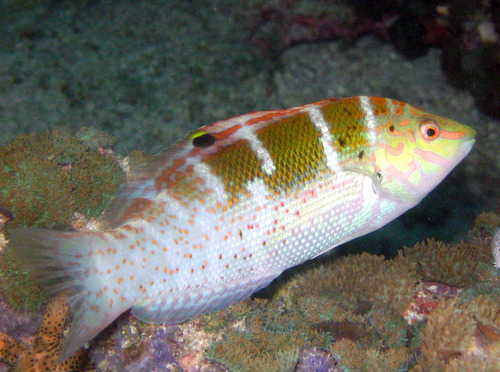
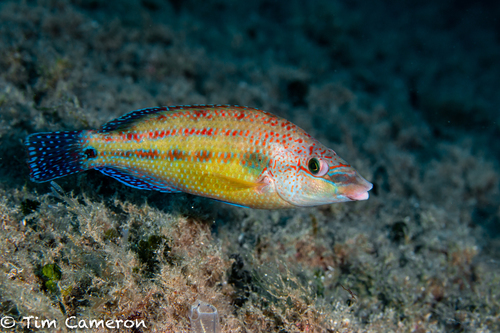
Both sexes have a small dark spot at the base of the caudal fin, and a dark blotch positioned just above the pectoral fin.
Body Spot Pattern
Many darker spots scattered across the body form 3 or 4 longitudinal stripes.
Sexual Dimorphism Note
The species' overall coloration shows clear sexual dimorphism.
Female and Juvenile Coloration
Females and juveniles are grey-greenish or brownish, fading to a silvery shade on the belly, and there are almost no visible color differences between immature males and mature females.
Male Coloration
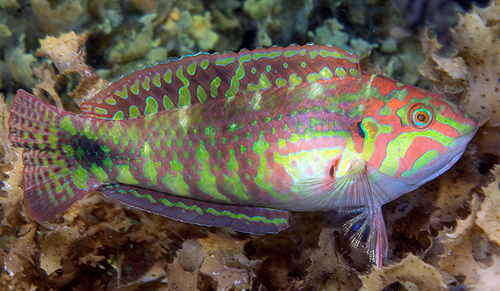
Males are more brightly colored, particularly during the breeding season; their base color ranges from pale green to green-bluish or green-yellowish, they have longitudinal rows of red spots, and the upper part of their head is dark blue.
Species Size
East Atlantic peacock wrasse can reach a standard length of 44 cm (17 in), though most individuals do not grow larger than 25 cm (9.8 in).
Human Harvest Use
Because of their relatively small size, this species is rarely targeted as a game fish, but it is sometimes sold locally for food when caught by small-scale local artisanal fisheries.
Aquarium Trade Use
It is also available in the aquarium trade.
Diet Composition
The peacock wrasse feeds on sea urchins, ophiuroids, bivalves, shrimps, and crabs.
Spawning Period
Spawning occurs in spring.
Spawning Behavior
During spawning, males build and guard a seaweed nest, and one or more females lay their adhesive eggs inside this nest.
Geographic Distribution
This species is native to the eastern Atlantic Ocean, ranging from Spain to Morocco, and is also found in the coastal waters of the Mediterranean Sea and the Black Sea.
Habitat Types
It is a gregarious littoral fish that lives on algae-covered rocky reefs, in seagrass meadows, around rocks surrounded by eelgrass, and can also occur in brackish lagoon waters.
Depth Range
It is found at depths between 1 and 50 m (3.3 to 164.0 ft).