About Eudocimus albus (Linnaeus, 1758)
Adult Plumage Basics
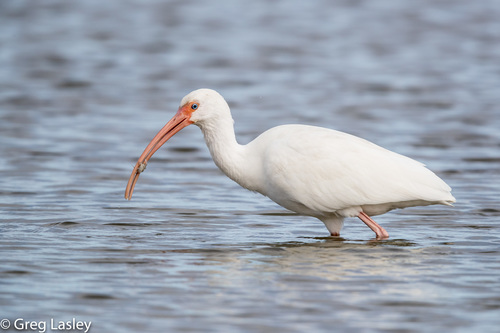
Adult American white ibises (Eudocimus albus) are easily identified by their distinctive white plumage and pink facial skin. Adults have black wingtips that are usually only visible when they are in flight.
Non-breeding Soft Part Color
In their non-breeding condition, their long downcurved bill and long legs are bright red-orange.
Breeding Soft Part Color Change
During the first ten days of the breeding season, the skin darkens to a deep pink on the bill and an almost purple-tinted red on the legs; after this period, the color fades to a paler pink, and the tip of the bill becomes blackish.
Sexual Monomorphism in Appearance
It is difficult to tell adult American white ibises apart by sex from external appearance alone, since both sexes have similar plumage.
Sexual Dimorphism in Size
However, this species does show sexual dimorphism in size and proportion: males are significantly larger and heavier than females, and have longer and stouter bills.
Adult Body Shape
The American white ibis is a moderately large ibis species, but compared to other large wading birds, it has relatively short legs and a compact, bulky build.
Weight Measurements
A study of this species in southern Florida recorded weight ranges of 872.9 to 1,261 g (1.924 to 2.780 lb) for males and 592.7 to 861.3 g (1.307 to 1.899 lb) for females, with average weights of 1,036.4 g (2.285 lb) for males and 764.5 g (1.685 lb) for females.
Length and Wingspan
The total body length of adult American white ibises of both sexes ranges from 53 to 70 cm (21 to 28 in), with a wingspan of 90 to 105 cm (35 to 41 in).
Standard Body Measurements
Standard body measurements for the species are: wing length 20.5–31 cm (8.1–12.2 in), tail length 9.3–12.2 cm (3.7–4.8 in), tarsus length 6.75–11.3 cm (2.66–4.45 in), and culmen length 11–16.9 cm (4.3–6.7 in).
Newly Hatched Down Feathers
Newly hatched American white ibises are covered in violet down feathers, which deepen to dark brown or black on the head and wings. The chest is often bare, and there may be a white tuft of down on the head.
Hatchling Iris and Skin Color
The irises are brown. Exposed skin is pinkish at first, except for the dark gray bill tip, and turns gray within a few days of hatching.
Hatchling Bill Development
At birth, the bill is short and straight, and has an egg tooth that falls off between five and nine days after hatching. Starting around day six, the bill develops three black rings, and turns gray by approximately six weeks of age.
Juvenile Plumage Growth
Gray to sandy gray brown juvenile plumage grows in between two and six weeks after hatching. A few weeks later, the face and bill turn pink, while the legs remain gray; by this stage, the irises have turned slate-gray.
Fledgling Appearance
After fledging, juvenile American white ibises have mostly brown plumage, with only the rump, underwing and underparts being white. Their legs become light orange at this point.
Molt to Adult Plumage
As the bird matures, white feathers begin to grow in on the back, and it undergoes a gradual molt to gain the full white adult plumage. This molt is mostly complete by the end of the second year, though some brown feathers may remain on the head and neck until the end of the third year.
Juvenile Growth Timeline
Juvenile birds take around two years to reach full adult size and weight.
Flight Formation
Like other ibis species, American white ibises fly with their neck and legs outstretched, often in long loose lines or V formations. A 1986 field study in North Carolina found that over 80% of adult ibises flew in these formations, and that juveniles quickly learned to adopt this practice over the course of the summer.
Formation Flight Benefit
Flying in these formations improves aerodynamics, which may lower the birds' energy expenditure.
Flight Movement Patterns
Flocks fly in an undulating pattern as they alternately flap their wings and glide. Circular soaring flight is also observed.
Long-distance Flight Height
American white ibises may reach heights of 500 to 1,000 m (1,600 to 3,300 ft) when gliding over flights of 20 km (12 mi) or more.
Typical Flight Parameters
More commonly, they fly between 60 and 100 m (200 and 330 ft) above the ground, either gliding or flapping at a rate of around 3.3 wingbeats per second.
Main Call Description
The main call of the American white ibis is a honking sound, transcribed as urnk, urnk, or hunk, hunk. This call is used during flight, courtship, or when the bird is disturbed.
Other Vocalizations
Birds also make a muted huu-huu-huu call while foraging, and produce a squealing call during courtship. Nestling young give a high-pitched zziu call as a begging signal.
Core Population Range
The American white ibis is most common in Florida, where over 30,000 individuals have been counted in a single breeding colony. It also lives throughout the Caribbean, on both coasts of Mexico from Baja California southwards, throughout Central America, and as far south as Colombia and Venezuela.
Non-breeding Range
The species' non-breeding range extends further inland, reaching north to Virginia, and west to eastern Texas.
Vagrant Records
The species is known to wander, and has been spotted, sometimes in small flocks, in states far outside its usual range.
North American Breeding Range
In North America, breeding occurs along the Atlantic coast from southern New Jersey south to Florida, and then west along the Gulf Coast. A breeding colony has been recorded at Laguna Cuyutlán, an isolated and regionally important wetland in the state of Colima on Mexico's west coast.
Breeding Site Fidelity
American white ibises are not faithful to their breeding sites; large breeding colonies of ten thousand birds or more can form and disband within one or two breeding seasons. Breeding populations across the species' range have fluctuated greatly, with large-scale movement between states.
Historical Breeding Distribution
Until the 1940s, the species only bred in large numbers in Florida, mostly within the Everglades. Drought conditions elsewhere in the United States led to more than 400,000 American white ibises breeding in the Everglades in the 1930s.
Breeding Range Expansion
In the 1950s and 1960s, large new colonies appeared in Alabama, Louisiana, then North and South Carolina and the Gulf Coast of Florida, and finally in Texas in the 1970s.
Breeding Colony Population Shifts
Between the 1970s and early 1990s, breeding colonies declined and disappeared in South Carolina and Florida, and increased greatly in North Carolina and Louisiana.
Colony Longevity Factors
Colonies persist for between one and 17 years, and their longevity is tied to the size and quality of nearby wetlands. The longest-lasting colonies are associated with wetlands larger than 800 km2 (310 sq mi).
Colony Abandonment Causes
Degradation of wetlands or breeding sites is the main reason colonies are abandoned. For example, the population of American white ibises in a colony at Pumpkinseed Island in Georgetown County, South Carolina, dropped from 10,000 to zero between 1989 and 1990 after Hurricane Hugo flooded nearby freshwater foraging areas with salt water.
Preferred Habitats
The American white ibis lives in a variety of habitats, though it prefers shallow coastal marshes, wetlands, and mangrove swamps. It is also commonly found in muddy pools, on mudflats, and even on wet lawns.
Inland Habitat Use
Inland populations away from the coast and shoreline, particularly in southern Florida, often live in other types of wetlands such as marshes, ponds, and flooded fields.
Seasonal Habitat Movement
In summer, these inland populations move to more coastal and estuarine habitats, because inland waterways become flooded with summer rains and the water becomes too deep for the ibises to forage effectively.