About Pseudechis porphyriacus (Shaw, 1794)
Scientific Nomenclature
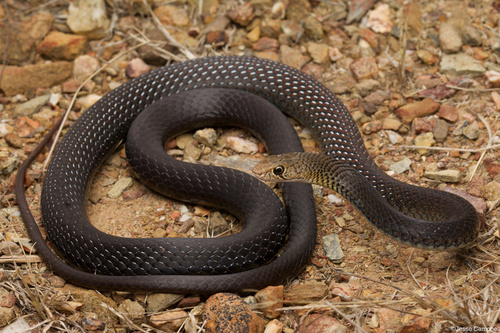
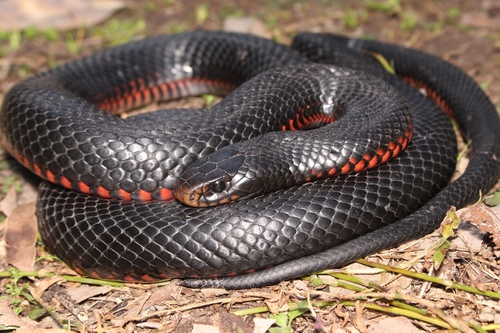
The red-bellied black snake, with the scientific name Pseudechis porphyriacus (Shaw, 1794), has a glossy black upper body, a light-grey snout, a brown mouth, and a completely black tail.
Head and Neck Morphology
It does not have a well-defined neck, as its head blends seamlessly into its body.
Body and Belly Coloration
Its flanks are bright red or orange, fading to pink or dull red on the belly, and all of these scales have black margins. Individuals from northern populations typically have lighter bellies that are more cream or pink in color.
Body Length
On average, this species reaches a total length (including the tail) of around 1.25 m (4 ft 1 in), and the longest recorded individual measured 2.55 m (8 ft 4 in). Males are generally slightly larger than females.
Body Weight
A large 2 m (6 ft 7 in) specimen caught in Newcastle has been estimated to weigh approximately 10 kg (22 lb).
Scent Characteristic
Red-bellied black snakes can have a strong scent, which some field experts use to locate them in the wild.
Dentition
Like all elapid snakes, it is proteroglyphous, meaning it has front fangs.
Similar Species
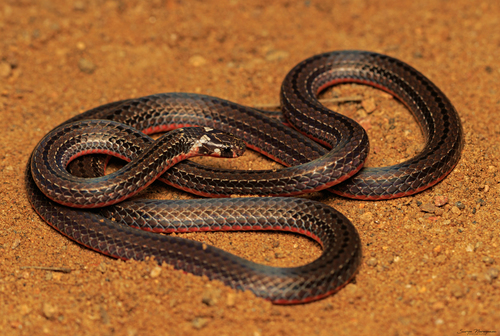
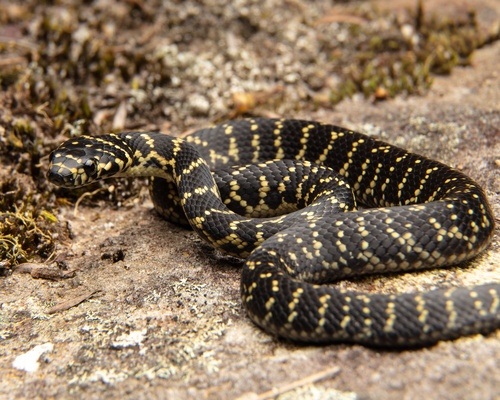
Juvenile red-bellied black snakes closely resemble the eastern small-eyed snake (Cryptophis nigrescens), and the two are easily confused, though eastern small-eyed snakes lack the red flanks seen in this species. Other similar species include the blue-bellied black snake (Pseudechis guttatus) and copperheads of the genus Austrelaps.
Historical Taxonomic Misconception
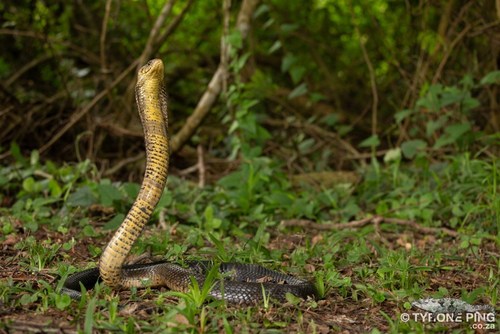
There was an early incorrect belief that the red-bellied black snake was sexually dimorphic, and that the eastern brown snake (Pseudonaja textilis) was its female form. Australian zoologist Gerard Krefft identified this error in his 1869 work Snakes of Australia.
Native Range
The red-bellied black snake is native to the east coast of Australia, where it is one of the most commonly encountered snakes. It occurs in urban forests, woodlands, plains, and bushland areas around the Blue Mountains, Canberra, Sydney, Brisbane, Melbourne, Cairns, and Adelaide.
Distribution Limits
In New South Wales, the Macquarie Marshes form the western border of its distribution, and Gladstone in central Queensland marks the northern limit of its main population. To the south, it is found across eastern and central Victoria, and extends along the Murray River into South Australia.
Disjunct Populations
Disjunct populations exist in the southern Mount Lofty Ranges of South Australia and in North Queensland.
Habitat Association with Water
The species is most often spotted close to dams, streams, billabongs, and other bodies of water, though it may travel up to 100 m (350 ft) away from water, including into nearby backyards. It specifically prefers shallow water areas with tangles of aquatic plants, logs, or debris.
Male Ritual Combat
In spring, male red-bellied black snakes often take part in ritualised combat that lasts between 2 and 30 minutes; they will even attack other males that are already mating with females. They wrestle vigorously but rarely bite, and participate in head-pushing contests where each snake uses its chin to try to push its opponent's head downward.
Mating Behavior
A male searches for a female, rubs his chin on her body, and may twitch and hiss, rarely biting, as he becomes aroused. The female signals that she is ready to mate by straightening her body and allowing the snakes' bodies to align.
Gestation Period
Gestation lasts from early spring to late summer. In late pregnancy, females become much less active and gather in small groups, sharing the same retreat and basking in the sun together.
Reproductive Strategy
The red-bellied black snake is ovoviviparous: after 14 weeks of gestation, usually in February or March, it gives birth to live young, each contained in an individual membranous sac. Between eight and 40 young are born, and they emerge from their sacs very shortly after birth.
Neonatal Characteristics
Newborn red-bellied black snakes have an average length of around 12.2 cm (4.8 in). In their first year of life, young snakes almost triple their length and increase their weight 18 times over.
Sexual Maturity
They reach sexual maturity when they attain a snout-to-vent length (SVL) of 78 cm (31 in) for males and 88 cm (35 in) for females. Females can breed at around 31 months of age, while males reach breeding maturity slightly earlier.
Lifespan
The red-bellied black snake can live up to 25 years.