About Naja subfulva Laurent, 1955
Taxonomy
This species is Naja subfulva, first described by Laurent in 1955.
Dorsal Body Coloration
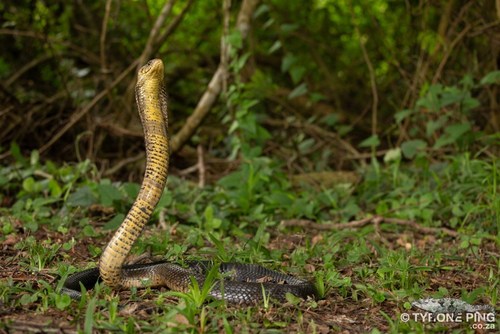
Most adult populations have a brown forebody that gradually darkens to black toward the tail; the lighter brown regions often have spots or mottled patterning. Adult individuals from the Lake Victoria area and parts of the Congo Basin are entirely black on their dorsal side.
Head Coloration
The sides and underside of the head are light, most often cream-colored, and the labial scales have dark edges, though these dark edges can be difficult to distinguish in some populations.
Ventral Coloration
The ventral side may become black toward the posterior end, or may stay light along its entire length.
Midbody Dorsal Scale Arrangement
At midbody, dorsal scales are arranged in 17 rows along the East African coast, and in 19 rows across all other parts of the species' range.
Ventral and Subcaudal Scale Count
This species has between 197 and 228 ventral scales, and between 57 and 70 subcaudal scales.
Maximum Recorded Length
The maximum recorded total length for the species is 269 cm.
Habitat
It is distributed across East and Central Africa, where it inhabits forests, thickets, and mostly wooded savanna environments.
Confirmed Distribution Range
Confirmed recorded populations come from South Africa, Mozambique, Zimbabwe, Zambia, Malawi, Angola, Tanzania, Kenya, Uganda, Rwanda, Burundi, Ethiopia, Somalia, South Sudan, the Democratic Republic of Congo, the Republic of Congo, the Central African Republic, Cameroon, and Chad.
Expected Occurrence
The species is also thought to probably occur in Nigeria.