About Dendroaspis jamesoni (Traill, 1843)
Scientific Naming and General Body Shape
Jameson's mamba (scientific name Dendroaspis jamesoni (Traill, 1843)) is a long, slender snake with smooth scales. Its tail typically makes up 20 to 25% of its total body length.
Adult Body Length
Adult Jameson's mambas have a total length (including tail) of around 1.5–2.2 m (4 ft 11 in – 7 ft 3 in), and the maximum recorded length is 2.64 m (8 ft 8 in).
Sexual Size Dimorphism
While the general agreement is that males and females are similar in size, fieldwork conducted in southeastern Nigeria found that males are significantly larger than females.
Body and Underbelly Coloration
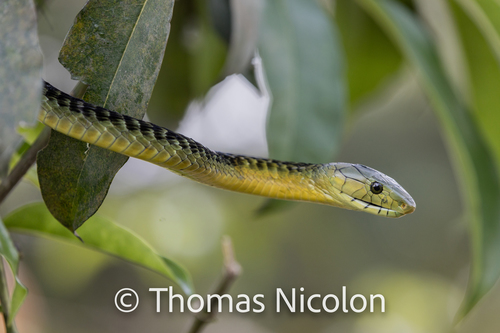
Adult individuals usually have a dull green colouration across the back that fades to pale green on the underbelly; most scales are edged with black. The neck, throat, and underparts are typically cream or yellowish.
Head Structure
Jameson's mamba has a narrow, elongated head, with small eyes and round pupils. Similar to the western green mamba, it can flatten its neck.
Subspecies Tail Coloration (Eastern Range)
The subspecies D. jamesoni kaimosae, which lives in the eastern part of the species' full range, has a black tail. Individuals from central and western parts of the range usually have a pale green or yellow tail.
Fang Structure
Its thin fangs are attached to the upper jaw, and have a furrow running along their anterior surface.
Overall Geographical Range
Jameson's mamba is found mostly in Central and West Africa, with some populations in parts of East Africa.
Central Africa Distribution
In Central Africa, its range extends from Angola north to the Democratic Republic of the Congo, Republic of the Congo, and Central African Republic, reaching as far north as the Imatong Mountains of South Sudan.
West Africa Distribution
In West Africa, it occurs from Ghana east to Togo, Nigeria, Cameroon, Equatorial Guinea, and Gabon.
East Africa Distribution
In East Africa, it can be found in Uganda, Kenya, Rwanda, Burundi, and Tanzania.
D. jamesoni kaimosae Endemic Range
The subspecies D. jamesoni kaimosae is endemic to East Africa. It is mainly found in western Kenya (where its type locality is located), as well as in Uganda, Rwanda, and the adjacent area of the Democratic Republic of the Congo.
Population Commonness and Sedentary Behavior
Jameson's mamba is a relatively common, widespread snake, especially across its western range. Fieldwork in Nigeria shows that the species is sedentary.
Natural Habitat Types and Elevation Range
It can be found in primary and secondary rainforests, woodland, forest-savanna, and deforested areas, at elevations up to 2,200 metres (7,200 ft).
Adaptability to Human-Altered Habitats
It is an adaptable species that can survive in areas with extensive deforestation and human development, and is often found near buildings, town parks, farmlands, and plantations.
Arboreal Tendency
Jameson's mamba is a highly arboreal snake; it is more arboreal than its close relatives the eastern green mamba and western green mamba, and much more arboreal than the black mamba. It is a highly agile snake.
Defensive Neck Flattening
Like other mambas, it can flatten its neck to mimic a cobra when it feels threatened.
Striking Capability
Its body shape and length let it strike from a significant distance.
General Temperament
It is generally not aggressive, and will typically attempt to escape when confronted.