About Harpactes kasumba (Raffles, 1822)
Sexual Dimorphism Introduction
The red-naped trogon, Harpactes kasumba, is a strongly sexually dimorphic species, with females generally being duller than males.
Male Plumage Details
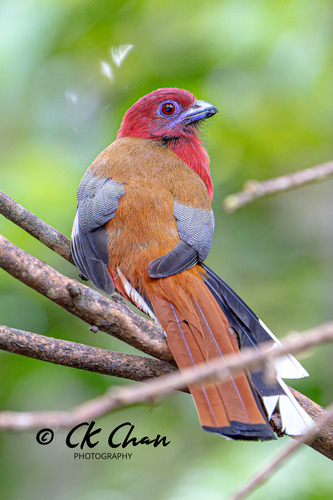
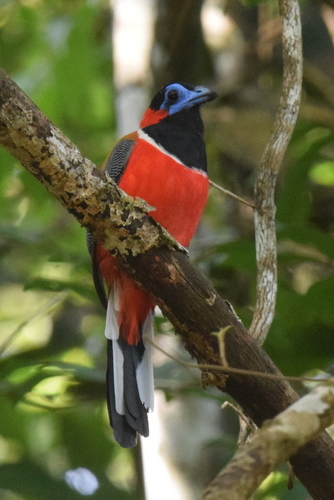
Males have a black head and upper breast, a blue bill and eye ring, and a bright blue face. They have yellow-brown upperparts and upper tail with black outlines, a white breast line, bright red underparts, and black-and-white undertail.
Species' Defining Characteristic
The species' defining characteristic, which gives it its name, is a band of bright red feathers across the back of the male's head.
Female Plumage Details
Females are plainer than males, with a grey-brown head and upper breast and yellow underparts.
Size and Lifespan
Both sexes reach up to 32 centimetres (12.5 inches) in length, and have an average lifespan of approximately 7.3 years.
Leg and Foot Structure
Their legs and feet are short and weak, so they cannot walk and are only able to shuffle occasionally along branches. For all trogons (family Trogonidae), leg muscle makes up only 3% of body weight, the lowest ratio recorded in any bird.
Toe Arrangement
The toe arrangement of trogons is unique among birds: it is heterodactylous, meaning the third and fourth toes point forward, while the first and second point backward. Because of this arrangement, red-naped trogons cannot turn around on a branch without help from their wings for movement.
Body and Wing Structure
They have compact bodies, short but strong wings, and a long tail. Wing muscle makes up approximately 22% of their body weight.
Flight Behavior
Despite having strong flight, red-naped trogons do not fly long distances, usually flying no more than a few hundred metres at a time.
Migratory Status
The red-naped trogon is a non-migratory sedentary species, staying in the same location year-round instead of migrating.
Geographic Range
It is restricted to the lowlands of Sundaic region (Sundaland), a biogeographical region in Southeast Asia that covers the Sunda shelf, the Asian mainland's Malay Peninsula, the large islands of Borneo, Java, and Sumatra, and their surrounding islands; the region's eastern boundary is the Wallace Line, which separates the Indomalaya and Australasia ecotones.
Distribution Area
The species' total distribution covers 989,000 km².
Population Status Overview
The global population size has not been quantified.
Regional Population Abundance
The species is described as rare in Thailand, fairly common in Peninsular Malaysia and Sumatra, rather scarce in Sarawak, and uncommon in Singapore, Indonesia, Sabah, and Brunei.
Population Decline Cause
The population is currently declining at a moderately rapid rate, due to habitat loss and degradation across the species' range.
Mature Individual Count
The number of mature individuals is unknown.
Population Fluctuation Status
The species does not experience extreme population fluctuations, but has a continuing decline in mature individuals.
Subpopulation Status
Its population is not severely fragmented, not all individuals belong to one subpopulation, continuing decline in subpopulations is unconfirmed, and subpopulations also do not experience extreme fluctuations.
Primary Habitat
Red-naped trogons occur mainly in primary or lightly logged lowland evergreen forests.
Elevation Range
They are most abundant below 600 metres, but have occasionally been found up to 1,200 metres in montane dipterocarp forest in Borneo.
Secondary Habitats
They have also been recorded in peat-swamp forest, logged areas, thick bamboo groves, coconut plantations, and cocoa plantations.