About Polyscias murrayi (F.Muell.) Harms
Taxon Identity and General Size
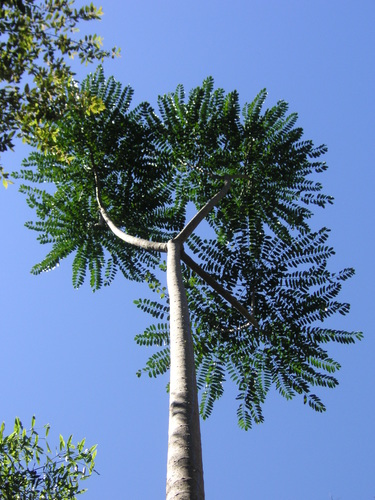
Polyscias murrayi (F.Muell.) Harms is a small to medium-sized tree that reaches a maximum height of 25 metres, with a maximum trunk diameter of 50 cm.
Trunk and Crown Structure
The end of its main trunk is unbranched, before splitting into a heavily branched crown. Its cylindrical trunk is mostly smooth, with a greyish or brown colour. The tree's base has no flanges, flutes, or buttresses.
Leaf Arrangement
Its leaves are alternate and pinnate, with between 8 and 30 leaflets. The leaflets are arranged opposite one another on the leaf stalk, and have either entire or toothed margins.
Leaflet Morphology
Leaflets are ovate lanceolate in shape and measure 8 to 15 cm long, though leaves on younger trees may be significantly larger. Leaf stalks can reach up to 120 cm in length, while leaflet stalks measure 3 to 8 mm long.
Leaf Stalk Gland and Midrib
A gland may be visible between each pair of leaflets on the leaf stalk. The midrib is white or paler green, and is raised on the underside of the leaf.
Leaf Venation
Leaf venation is more easily visible on the upper surface of the leaf.
Flower Characteristics and Bloom Period
Creamy green flowers grow on stalks arranged in umbels, and bloom between February and March.
Fruit Characteristics
Its fruit is a blue drupe, which usually has two lobes, though occasionally it may have three. The fruit matures between April and June.
Germination Rate
Germination from fresh seed occurs at a slow rate.
Faunal Associations
A variety of bird species eat the fruit, including the brown cuckoo dove, Lewin's honeyeater, rose crowned fruit dove, satin bowerbird, and superb fruit dove.
Use in Bush Regeneration
For bush regenerators, Polyscias murrayi is a useful nursery tree, as it provides shade for longer-lived young trees growing underneath it.
Ornamental Use
It is also grown as an attractive ornamental tree.