About Hedera algeriensis Hibberd
Nomenclature and Growth Habit
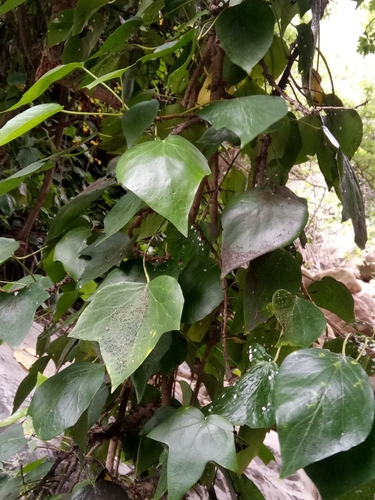
Hedera algeriensis Hibberd is a vigorous, large evergreen climbing plant that self-clings to surfaces via aerial roots.
Stem Characteristics
Its stems are reddish, and partially covered in stellate hairs or scales; these reddish star-shaped structures have approximately 15 rays.
Basic Leaf Traits
The leaves are alternate and simple.
Leaf Variation by Branch Type
Like other Hedera species, fertile branches of Hedera algeriensis have stiff stems, and their leaves usually have fewer lobes than the leaves on sterile (juvenile) stems.
Fertile Branch Leaf Morphology
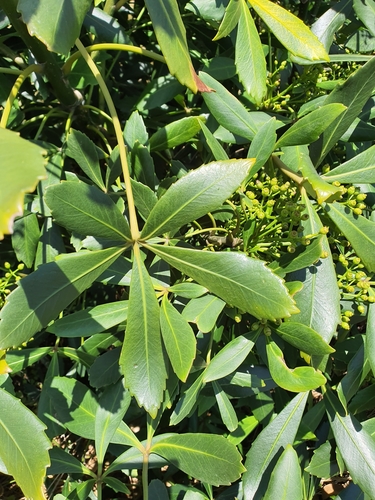
On flowering branches, the leaf blade is oval-rhombic, measuring 12–20 cm long by 5–12 cm wide.
Sterile Stem Leaf Morphology
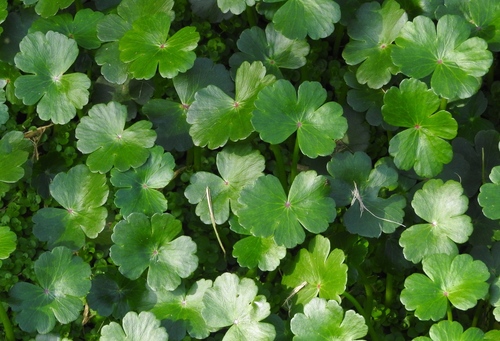
Leaves on sterile stems are coarsely toothed or slightly lobed, with 3–5 lobes.
Inflorescence Structure
The inflorescence forms a cluster of 13–15 hairy flowers.
Flower Growth Traits
Small flowers grow in umbels, and only develop on fertile stems or branches.
Toxic Compound Content
The plant contains the glycoside hederagenin, concentrated mostly in its leaves and berries.
Toxicity Effects
This compound can cause mild toxicosis; ingestion of these plant parts may lead to severe discomfort, and handling the plant may trigger skin irritation or an allergic reaction.
Invasive Potential
In terms of ecology, Hedera algeriensis may become a noxious weed or invasive species.
Naturalization Habitats
It naturalizes in mild climates and lowland areas.
Soil Moisture Requirements
It needs consistently moist soil, but is more resistant to dry conditions than most closely related species, and tolerates drought better than other ivies.
Cold Tolerance Comparison
It also tolerates low temperatures better than island Hedera species from similar latitudes, including Hedera canariensis, Hedera maderensis, Hedera azorica, and Hedera cypria.
Native Range
This species is native to the North African coast and its coastal mountains, where the climate is cooler and condensation creates a more humid habitat.
Frost Tolerance and Naturalization
It is frost sensitive at the -2 °C winter isotherm, but can become naturalized in mild climates.
Herbivory Resistance
Herbivorous animals reject this plant as food.
Horticultural Use
Variegated cultivars of Hedera algeriensis are widely used in gardening.
Evolutionary Origins
Hedera algeriensis evolved from a common ancestor that occupied cloud forest habitats in the Mediterranean area.
Congeneric Relationships
Northern African Hedera species and northeast Atlantic species of the genus Hedera are closely related.
Taxonomic History
Until recently, researchers grouped many of these forms under a single species, Hedera helix, but recent studies have shown that the group actually contains several separate species that differ mainly in microscopic details of the hairiness of their buds.
Closely Related Species
Hedera maroccana, Hedera iberica, and Hedera canariensis are closely related to Hedera algeriensis.