About Pionus menstruus (Linnaeus, 1766)
Common and Scientific Name
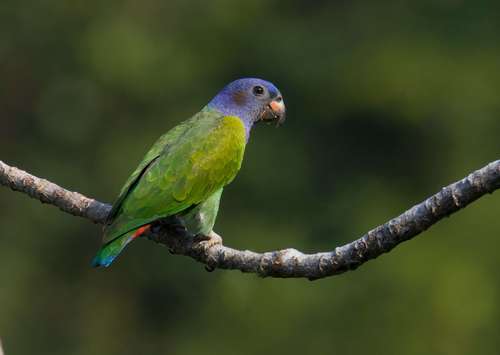
The blue-headed parrot, also known by the scientific name Pionus menstruus, is approximately 28 cm (11 inches) long and weighs 245 g (8.6 oz).
Body Plumage
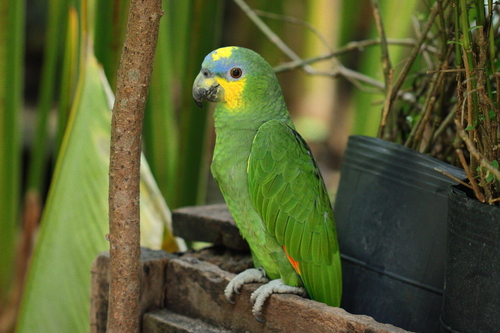
Its body is primarily green, with blue coloring on its head, neck, and upper breast.
Distinct Markings
It has red undertail coverts, some yellowish coloring on its wing coverts, dark ear patches, and an upper mandible that is black with reddish areas on both sides.
Subspecies Count
Alongside the widespread nominate subspecies that occurs across most of the species' South American range, there are two additional more localized subspecies.
rubrigularis Subspecies
The subspecies rubrigularis, found in southern Central America and the Chocó, has overall paler plumage and typically has a relatively distinct pinkish patch on the throat.
reichenowi Subspecies
The subspecies reichenowi, found in the Atlantic Forest of eastern Brazil, has a paler bill and blue coloring on most of its underparts.
Adult Sexual Dimorphism
Males and females look identical across all subspecies.
Juvenile Plumage
Juvenile birds have less blue on the head, plus red or pinkish feathers around the ceres.
Plumage Maturation
Juveniles moult into adult plumage at around 8 months of age, but it may take up to two years for their full blue head coloration to fully develop.
Amazon Range
In terms of range, this species is primarily found across the Amazon region of South America, with its eastern limit reaching the neighboring Araguaia-Tocantins River system in the southeast.
Brazilian Atlantic Coastal Range
A separate disjunct population occurs along a roughly 1500-kilometer coastal strip on Brazil's South Atlantic coast, extending from Pernambuco in the north to Espírito Santo state in the south.
Central American Range
In northwestern South America, the species' range continues north into Central America, reaching from Panama to Costa Rica.
Range Exclusions
It does not occur on the northern Andes cordillera spine, nor does it occur in a smaller contiguous area of central Venezuela and northern Colombia.
Pacific Coastal Range
Its range also extends along a Pacific coastal strip from southern Ecuador north to the Caribbean areas of northwestern Colombia and western Venezuela.
Diet
Blue-headed parrots feed on fruit, flowers, seeds, and occasionally grain.