About Eolophus roseicapilla (Vieillot, 1817)
Description
Size
The galah, Eolophus roseicapilla, is approximately 35 cm (14 in) long and weighs 270–350 g (10–12 oz).
Plumage Features
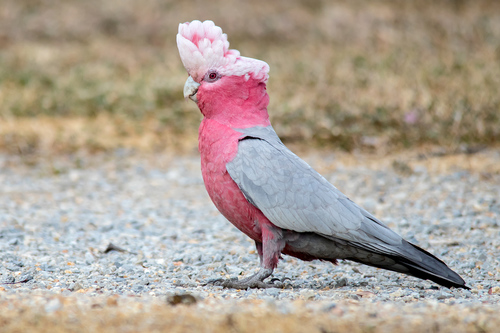
It has a pale silver to grey back, a pale grey rump, a pink face and breast, and a light pink mobile crest.
Soft Tissue Traits
Its beak is bone-coloured, the bare skin of its eye ring is carunculated, and it has grey legs.
Sexual Dimorphism
The sexes look generally similar, but adult birds differ in iris colour: males have very dark brown, almost black irises, while females have mid-brown or red irises.
Juvenile Traits
Adults have brighter colouration than juveniles. Juveniles have a greyish breast, crown, and crest, brown irises, and whitish non-carunculated eye rings.
Distribution and habitat
Australian Native Range
The galah lives throughout Australia, and is only absent from the driest regions and the far north of Cape York Peninsula.
Tasmanian Introduction
It was introduced to Tasmania by human activity, with no recorded sightings there before 1848. A large population expansion happened in the 1960s after many captive galahs escaped.
Common Habitats
It is common in major metropolitan areas including Adelaide, Perth, and Melbourne, and abundant in open habitats that provide at least some scattered trees for shelter. It is common in nearly all habitats across its range, except for dense forests, particularly high-rainfall dense forests.
Coastal Colonisation
While it mostly inhabits inland areas, the galah is rapidly colonising coastal regions.
Beneficial Human Impacts
Changes caused by European settlement, which have been harmful to many other species, have been very beneficial for the galah: this is due to the clearing of forests in fertile areas, and the addition of stock-watering points in arid zones.
New Zealand Introduction
The galah was also introduced to New Zealand in the late 20th century, and has become established in the South Auckland area.
As food
Humans have eaten galahs historically. Recipes for galah meat were published in Australian newspapers in the 1930s, alongside jokes about the supposed toughness and unpalatable taste of the bird's flesh.