About Podiceps major (Boddaert, 1783)
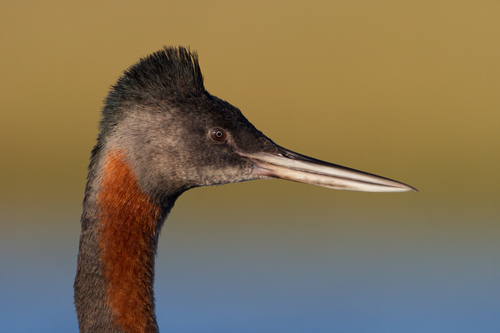
The great grebe, scientifically named Podiceps major (Boddaert, 1783), is a very large grebe with body proportions more similar to a goose or cormorant than to a typical grebe.
Size Measurements
Adults measure 67 to 80 cm (26.5 to 31.5 inches) in length. They usually weigh around 1,600 grams (3.5 pounds), and can reach at least 2 kg (4.4 lb).
Plumage Features
Their neck and chest are buffy-rufous, their back is blackish, and their belly is whitish. The head is sooty gray, and they have a reddish-brown eye.
Identification Distinctiveness
Because of its large size and distinctive color pattern, the great grebe is not easily mistaken for any other bird, including other grebe species.
Primary Habitats
This species lives primarily in open water habitats. Most individuals are found on low-altitude lakes and slow-moving rivers, which are often surrounded by forests, as well as estuarine marshes.
Breeding Season Habitat
During the breeding season, it commonly uses heavily vegetated inlets connected to large lakes.
Non-breeding Habitat
Outside of the breeding season, most individuals move to estuaries and bays that usually have dense kelp growth; occasionally, great grebes can even be spotted on the open sea. Non-breeding great grebes may stay along coasts year-round.
Conservation Status
The species is widespread and common across most of its range, and much of its native habitat remains intact, particularly in the southern parts of its range.