About Podiceps occipitalis Garnot, 1826
Length
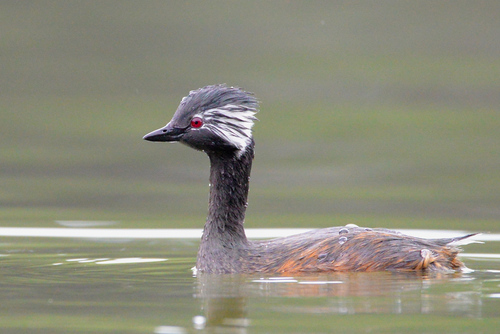
The silvery grebe (Podiceps occipitalis Garnot, 1826) reaches approximately 28 cm (11 in) in length.
Subspecies Variation Basis
It has two recognized subspecies that differ in the coloration of their head and facial plumes.
Southern Subspecies Head Coloration
For the southern subspecies, the ear plumes are yellowish, and the sides of the head and throat are grey.
Northern Subspecies Head Coloration
For the northern subspecies, the ear plumes are grey, and the sides of the head and throat are white.
Shared Plumage Patterns
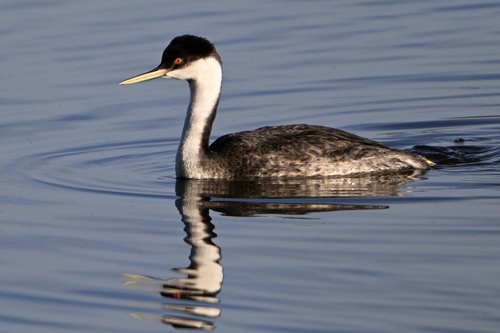
Both subspecies share the same general plumage pattern: a black crown, white neck, chest and belly, dark grey back, and blackish sides and flanks.
Shared Soft Part Features
Both also have black beaks and feet, and red eyes.
Similar Species Overlap
The northern subspecies in particular looks similar to the rare, highly localized Junin grebe (Podiceps taczanowskii), and the two species have overlapping ranges.
Breeding Range
The silvery grebe nests in Argentina, the Falkland Islands, Chile, and the western parts of Bolivia, Peru, Ecuador and Colombia.
Southern Subspecies Migration
The southern silvery grebe is migratory; in winter it ranges north to Paraguay, southern Bolivia and southern Brazil, and possibly also occurs in Uruguay.
General Habitat Type
Its habitat consists of freshwater lakes, lagoons, reservoirs and ponds.
Andean Habitat Preference
In the Andes, it generally prefers weakly alkaline lakes, and is sometimes found foraging on hypersaline lakes.
Patagonian Habitat Association
In Patagonia, it sometimes lives in saline lakes, where it can be seen alongside flamingoes.