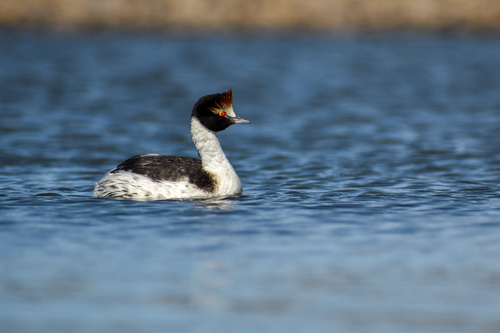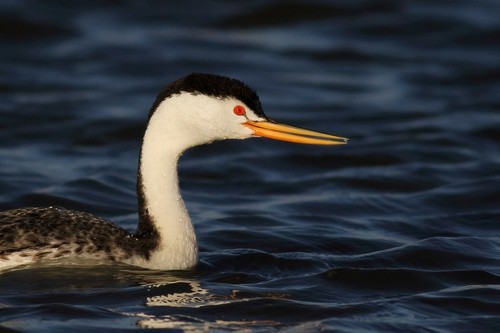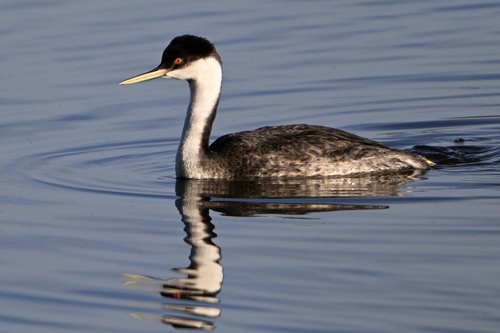
About Aechmophorus occidentalis (Lawrence, 1858)
Taxonomy and General Status
The western grebe (scientific name Aechmophorus occidentalis (Lawrence, 1858)) is the largest grebe species native to North America.
Size Measurements
It measures 55–75 cm (22–30 in) in length, weighs 795–2,000 g (1.753–4.409 lb), and has a wingspan of 79–102 cm (31–40 in).
Adult Plumage and Physical Features
Its plumage is black and white, it has a long, slender, swan-like neck, and red eyes.
Similarity to Clark's Grebe
It is easily confused with Clark's grebe, which shares similar features, body size, behavior, and habitat, and hybrids between the two species are known.
Range Difference from Clark's Grebe
Clark's grebes generally occupy more of the southern part of North America than western grebes.
Plumage Difference from Clark's Grebe
Other differences between the two species include that Clark's grebe has whiter flanks and a paler gray back compared to the western grebe.
Facial and Bill Difference from Clark's Grebe
The western grebe has black plumage around the eyes and a straight greenish-yellow bill, while Clark's grebe has white plumage around the eyes and an up-turned bright yellow bill.
Downy Young Color Difference
Downy young western grebes are grey, while downy young Clark's grebes are white.
Species Distribution
This waterbird species is widespread across western North America, with no single specific area where it is especially abundant.
Nesting Habitat
Western grebes nest in colonies on lakes that have a mix of marsh vegetation and open water.
Nest Construction Materials
Their nests are built from plant debris and sodden materials.
Nest Building Timeline and Participants
Nest building generally begins between late April and June, and is carried out by both members of a breeding pair.
Construction During Breeding Period
Construction continues throughout egg laying and incubation.
Clutch Size Seasonal Trend
Clutch size in western grebes decreases as the mating season progresses, meaning pairs that mate later in the mating season produce fewer offspring.
Contradictory Brood Size Observation
However, some sources note that brood size of nests that hatch later in the season is larger than those that hatch earlier, which contradicts this finding.
Explanation for Size Discrepancy
This discrepancy may be caused by ecological constraints.
Siblicide in Young Grebes
Ecological constraints also put pressure on young western grebes, which can lead to siblicide in the first weeks after hatching, and this may explain the observed differences in brood size.
Sensitivity to Human Disturbance
Western grebes are sensitive to human activity: when humans disturb them near their nests, parent birds leave the nest, leaving unhatched eggs vulnerable to predator attacks.
Impact of Disturbance on Survival
This means that predation, or even seemingly threatening human activity, leads to reduced reproduction and lower survival of young western grebes.
Habitat Restoration Efforts
Because of this sensitivity, restoration efforts have been carried out to rebuild the species' native habitats, to give western grebes better opportunities to reproduce and raise their young without disturbance or threat.
Population Trend
Western grebe populations have declined slowly over the last two decades.
Threats to Population
This decline is caused not only by predation, but also by habitat destruction, with oil spillage being one of the major causes.
Prey Items
Western grebes dive to catch prey including carp, herring, mollusks, crabs, and amphibians such as salamanders.
Pre-dive Behavior
They often peer below the surface of the water before diving.
Foraging Depth
Recent observations indicate that western grebes dive to the bottom of lakes to forage.
Prey Capture Methods
They impale some smaller fish with their bill in a manner similar to herons, but grasp other fish.
Prey Consumption Process
Most prey is swallowed underwater, but some prey is brought to the surface, pinched, and then swallowed.